Emerging Pensees
thoughts on God, faith, life, and the emerging church... btw, "pensees" is French for thoughts. get your mind out of the gutter ;)
about


Name: Mike Clawson
From: Austin, Texas, United States
About me: A follower of the way of Christ, a "postmodern" Christian, an amateur theologian/ philosopher, a husband, a father, a student, a friend...
More..
Contact: mike(dot)clawson
(at)gmail(dot)com


My Facebook Profile:
http://www.facebook.com/ mike.clawson1
Blog Categories
  • - atheism
  • - book reviews
  • - emerging church
  • - Emma
  • - Aidan
  • - fun
  • - personal
  • - politics
  • - social justice
  • - theology
Tony Jones on why it matters that Jesus REALLY rose. Does it also matter that Adam and Eve were really two historical figures who lived in a physical Garden, and were forced to leave after an incident involving a real talking snake and an actual piece of fruit on an actual tree?

It seems to me that the logic of the two paragraphs above flows just as well, with some minor changes, for the story in Genesis 2. For example "Why is that important? Because I'm a real person" goes through unchanged. "Thus, since the resurrection of Jesus is his defeat of death, evil, and grief, it's important to me that it really happened" becomes "Thus, since the story of Adam and Eve is the story of how sin entered the world, it's important to me that it really happened." And so on. But I think you don't consider the Adam and Eve story accurate on a factual level? So why the difference?
Autumnal, I don't know if you clicked on the link to Tony's complete post - but he acknowledges just that question, so if you haven't, I recommend that you should.

My own partial answer is that a lot of the Genesis stuff reads like poetry (ch. 1) and like "once upon a time" storytelling (ch. 2-11, at least). They say some important things theologically (God is Creator; Creation is good; all people, male and female, are in God's image). But they clearly don't answer (and I think, aren't meant to answer) factual questions about creation. The creation stories in Gen 1 and 2 are different, for one example; there's no account for the other people and cities that Cain encounters, for another.

The Jesus narratives are different. Luke and John, for example, take pains to say that there were eyewitnesses - historical figures living in a physical world - reporting what they saw and experienced. Luke says he made careful investigation; John says he was there and tells what he saw. They're claiming it's not myth, but fact.

People may not accept those claims. But in my opinion, it does violence to the text to claim some inspiration or "mythical truth" in the Jesus narratives while dismissing the author's claims to be reporting factual events. "These guys are liars but they lie so well!"

I can't see much point in giving my life to follow a nice story. When I'm in someone's hospital room watching their last moments, it's no comfort to me that Gandalf came back from death. It's the actuality of Jesus's Resurrection that makes the difference.
AH - like Chris said, Tony did address your question in the post, though not thoroughly. Personally I'd say two things:

1) Interpreting scripture doesn't need to be an all-or-nothing thing. Just because I read parts of it as figurative doesn't mean I have to read all of it as that, or vice versa. The Bible isn't one single book. It's an anthology of lots of different writings, containing many different genres, so, as Chris has argued, it's important to read the different parts for what they are, and not try to apply the same literary standards to each different piece.

2) As to whether the argument for the historicity of the Resurrection also applies to Adam and Eve, I don't think so. What's important about that story is that something did go wrong, sin did, at some point, enter the world. Whether or not it happened exactly like that doesn't matter so much IMHO. What is important is what the story represents, and that is pretty much the same regardless of whether or not it actually happened.

As for the Resurrection, I think it is also important what the story represents. However, in this case, what it represents is very different depending on whether or not it actually happened. If the Resurrection is purely figurative/mythic, then it can still have some significance certainly, but not quite the same meaning and significance, I think, as if Jesus actually rose. I disagree with Tony that liberal Christianity is "impotent", but I do think that it hasn't tapped into the full power that can come with a belief in the historical, physical Resurrection of Jesus. The historical Resurrection can also include all the significance and power of a purely figurative Resurrection, and a whole lot more besides.
I find it disappointing that the worth of Christianity is hung on its founder's last three days rather than the three years of his ministry.

For me, I follow Jesus because of how he lived rather than how he died (and then undied). I'd still try to follow him if he died a withered, old man rather than a beaten, young man.

But, then, I'm weird. Or so I've been told.
Thanks, Chris, Mike, that makes sense.

"These guys are liars but they lie so well!". . .it's no comfort to me that Gandalf came back from death.Hee, hee!
David - I wouldn't say that the Passion and Resurrection is more important than life of Jesus. Rather, the language of the New Testament implies that the Resurrection serves as a vindication of the life and message of Jesus. The Passion is the demonstration and fulfillment of everything Jesus has been talking about - i.e. non-violent resistance to the powers and ideologies of domination, exclusion, and violence - and the Resurrection is the vindication that this resistance is not merely suicidal idealism. New Christians and the Neo-Calvinists The certainty issue is a problem I would see especially for those in a Reformed tradition. To say that I am certain of my understanding of the Gospel seems to mitigate the absolute sovereignty of God. Certainty seems to rely on a type of objectivity that even scientists will admit is not exactly an accurate understanding of human knowledge. By saying that one is certain about an interpretation of revelation, there is simply no room for a continuing revelation to falsify any claim made to certainty. Seems like the same problem that Jesus had with the Pharisees and Scribes no? The problem with not having your theology nailed down is the traditional Christian view that one must believe in or accept Jesus Christ in order to avoid going to Hell. If you don't believe in Hell or that God will annihilate you for believing in error, then not having your theology nailed down (is this a pun?) is not that big a deal.

Having one's theology nailed down can help a believer through cultural crises. We live in some very uncertain times - the traditional lines of right and wrong are blurred or have shifted completely. People are left without an anchor, and with so many different voices and side clamoring to be heard, it can be difficult to determine the right or best course of action. 'Knowing' what God wants or thinks about a given situation can provide security and help give the true-believer peace of mind.

Sudo
FYI, "neo-calvinism" generally means something different than how you are using the term. Well I don't know what to call them now. It seems every good descriptor is already taken. I got "Neo-Calvinists" from someone else (Hansen himself maybe?), and when I referred to them at the Radical Reformed in my first article, I was told that the Anabaptists already have a claim on that one. So what would you suggest we call them? I'm not sure what to call them. Even "Young Reformed" is a name I don't like since, taken literally, describes me and many of the folks at my church. But I don't really consider ourselves to be part of this group that Hansen writes about. I find myself quite often disagreeing with Piper, MacArthur, Mohler, Driscoll, etc. Actually, I think the main difference I have with them is similar to the difference Tony was talking about - having more to do with epistemology than with theology. I think most of these young Reformed folks would line up philosophically next to people like J.P. Moreland and William Lane Craig, whereas I find myself closer to people like James K.A. Smith and Merold Westphal. (BTW, for those who don't know - Moreland and Craig aren't Reformed while Smith and Westphal are.) Book Review: The New Christians

Recent Reads

  • The Uses of Haiti
    by Paul Farmer


  • Putting Away Childish Things
    by Marcus Borg


  • An Unbroken Agony: Haiti, from Revolution to the Kidnapping of a President by Randall Robinson

  • Haiti in Focus: A Guide to the People, Politics, and Culture by Charles Arthur

  • Mind & Emergence: From Quantum to Consciousness
    by Philip Clayton

  • Namaah's Curse by Jacqueline Carey


  • Watchmen by Alan Moore & Dave Gibbons


Friend's Sites
  • onehandclapping
    -Julie Clawson

  • fluctuating certainty
    -Karen Gerber

  • Danno's Dangerous Mind
    -Dan Horwedel

  • T(r)oy Marbles
    -Troy Cady

  • Anglobaptist
    -Tripp Hudgins

  • The Thinkulum
    -Andy Culbertson

  • A Little Off Key
    -Amy Toornstra

  • unconventionalwisdom
    -Jen Pare

  • (Not So) Straight from Seminary
    -Brandy Daniels

  • MattTheTroll
    -Matt Cavanaugh

  • Love is the most excellent way
    -Helen Mildenhall

  • Disonanz Cognitif
    -Derek Berner

  • Wild Rumpus
    -Rebecca Murphy

  • This Just In...
    -Inouye Family

  • Discovering Pathways
    -Laurel Dixon

  • Postmodern Questions
    -Thomas Just

  • Clawson Family Blog


Classic Pensees
  • - What is the Emerging Church?
  • - The Converging Church
  • - How to Read the Bible
  • - Did the Exodus Really Happen?
  • - Hell Q&A
  • - Three Approaches to Scripture
  • - Does Forgiveness Require Repentance?
  • - Emma at the Petting Zoo
  • - Biblical Support for Women in Ministry
  • - What is Sin?
  • - What Good is the Bible?
  • - The God of Thin Places
  • - Immigration: Real Solutions
  • - What is Postmodernism?
  • - V for Vendetta
  • - What is Justice?
  • - Roots
  • - If It's Good Enough for Kids...
  • - Aslan Is Not Jesus
  • - Community Transformation
  • - Theology is Like Designing a House
  • - When I Am Weak...
  • - Why I'm Not Patriotic
  • - What is Truth?
  • - What this "postmodern" journey is all about...
  • - The Relational Nature of Sin
  • - Caught In-Between
  • - Three Routes of Escape
  • - What If God Really Existed?
  • - A Tale of Two Churches
  • - Cautions for Emergents, Part 1
  • - Cautions for Emergents, Part 2
  • - We Were There First
  • - Take NAFTA for instance...
  • - Let Them Come
  • - A New Perspective on Jesus
  • - Was Jesus Political?
  • - Contextualization or Isolation: Then and Now
  • - A Tale of Two Movements
  • - Abortion: Talking Past Each Other
  • - Epistemology or Ethics
  • - Why Faith?
  • - A Failure of Compassion
  • - Parables Aren't Always About God
  • - Do You Have a Soul?
  • - Is it all just trivial?
  • - What about the Disturbing Parts of the Bible?
  • - Into the Woods
  • - American Exceptionalism or Imperialism?
  • - Why Believe In God?
  • - Owning "Emergent"

Previous entries
  • Are Emergents Merely Liberal?
  • Liberalism, Evangelicalism and Emergence
  • The Wild Goose as a Sign of Hope
  • Blog Hiatus... Obviously
  • Review of Marcus Borg's "Putting Away Childish Thi...
  • Favorite Austin Eats
  • Busy Summer
  • Escobar on New Men and Social Change
  • Walker Cleaveland's "Brief History of Presbymergent"
  • More Conferences


Friend of Emergent Village

Join the Emergent/C Mailing List
Email:


The Gross National Debt


Locations of visitors to this page

Recommended

Julie's Book!
Events


Big Tent Christianity
Raleigh, NC
Sept 8-9


Emergent Village Theological Conversation
Atlanta, GA
Nov 1-3

Sites
  • - Emerging Women
  • - Emerging Parents
  • - Emergent Village
  • - The Ooze
  • - Next-Wave Ezine
  • - NT Wright Page
  • - Disassemblance
  • - Dylan's Lectionary Blog
  • - Mustard Seed Associates
  • - Everything Must Change
  • - Via Christus Comm. Church
  • - up/rooted
  • - Wedding Pastors USA
  • - Shieldmaiden Designs
  • - Fifty Percenters

Blogs
  • God's Politics
  • Jesus Creed
  • Friendly Atheist
  • Reclaiming the Mission
  • Emerging CGGC
  • Out of Ur
  • Theolog
  • tallskinnykiwi
  • John Armstrong
  • Paradoxology
  • Bob.Blog
  • Kingdom Grace
  • Frenetic Peace
  • Decompressing Faith
  • iamjoshbrown
  • the carnival in my head
  • Tony Jones
  • Empire Remixed
  • brianmclaren.net
  • Revolution in Jesusland
  • With/out God

Political Stuff
  • - Sojourners
  • - New Evangelical Partnership for the Common Good
  • - Progressive Christian Alliance
  • - Green Party
  • - Global Exchange
  • - The One Campaign to Make Poverty History

Books
  • A New Kind of Christianity by Brian McLaren


  • The Secret Message of Jesus by Brian McLaren


  • Velvet Elvis by Rob Bell


  • The Challenge of Jesus by N.T. Wright


  • The Gospel in a Pluralist Society by Lesslie Newbigin


  • A Generous Orthodoxy by Brian McLaren


  • Church Re-Imagined by Doug Pagitt


  • Traveling Mercies by Anne Lamott


  • Till We Have Faces by C.S. Lewis


  • Fear & Trembling by Soren Kierkegaard


  • Messy Spirituality by Mike Yaconelli


  • God's Politics by Jim Wallis


Articles
  • - What is the Emerging Church?
  • - Recommended Reading for the Emerging Church
  • - Emerging Church Resources
  • - Obama on Faith & Politics
  • - Mars Hill's Directions
  • - Profoundly Disturbed on the 4th of July
  • - 10 Key Values of the Green Party
  • - NT Wright on Penal Substitution
  • - Walter Wink on The Myth of Redemptive Violence
  • - Mark Twain's War Prayer
  • - Rebuttals to Richard Dawkins
  • - Day in the Life of Joe Middle-Class Republican

Music

  • U2 - How to Dismantle an Atomic Bomb


  • Green Day - American Idiot


  • David Wilcox - Into the Mystery


  • Caedmon's Call - Share the Well


  • Passion: Hymns Ancient and Modern


  • Jake Armerding


  • Tourniquet - Vanishing Lessons


Viewing

  • The Lord of the Rings


  • Star Wars Trilogy


  • Fight Club


  • Garden State


  • Saved!


  • Joan of Arcadia


  • Magnolia


  • Donnie Darko


  • High Fidelity


  • The Mission


  • Futurama


  • The Simpsons


Emerging Churches
  • Mosaic - Los Angeles, CA

  • Vintage Faith Church - Santa Cruz, CA

  • Church of Jesus Christ, Reconciler - Chicago, IL

  • Wicker Park Grace - Chicago, IL

  • The Emmaus Community - Chicago Heights, IL

  • Fusion Church - Lake Zurich, IL

  • Life on the Vine - Long Grove, IL

  • Mars Hill - Grandville, MI

  • Waters Edge - Hudsonville, MI

  • Threads Church - Kalamazoo, MI

  • Solomon's Porch - Minneapolis, MN

  • Oasis Madrid - Madrid, Spain

  • Mosaic - Austin, TX

  • Vineyard Community Church - Shoreline, WA

Sunday, May 10, 2009
Tony Jones on why it matters that Jesus REALLY rose.
Tony has some good thoughts up about why he doesn't like the "package deal" among liberal Christians, where it is assumed that if you support GLBT rights (as Tony does, as do I) and other similar causes, you must therefore also reject the historical, physical reality of the Resurrection of Jesus (which Tony does not, nor do I). He writes:
Why is that important? Because I'm a real person. Because the people to whom I have ministered in Jesus' name are real persons. We're not hypotheses, fables, or legends. And we need real healing, all of us. While our realities may be largely socially constructed, we have real DNA, real physical, material properties.

Thus, since the resurrection of Jesus is his defeat of death, evil, and grief, it's important to me that it really happened. Without a resurrected Jesus, Christianity is impotent. (Exhibit A: liberal Christianity) And I don't mean a Jesus who was "resurrected" in the Disciples' hearts, and in my heart. I mean a real resurrection in the space-time continuum by a physical being known as Jesus of Nazareth, as 99.99% of Christians for the last two milennia have believed.
Read the whole post here.

Labels: theology, Tony Jones

 
posted by Mike Clawson at 10:52 PM | Permalink | 6 comments
Saturday, May 03, 2008
New Christians and the Neo-Calvinists
Tony Jones is having a "blogalouge" with Christianity Today editor Collin Hansen. A couple years ago Hansen wrote an article for CT about the "Young, Restless, Reformed" movement among evangelicals which turned into a book. This is a parallel movement to the emerging church primarily among young evangelical men who are attracted to Calvinistic doctrine and a restrictive view of female leadership in the church. Key influencers in this movement are John Piper, and of course, Mark Driscoll, though others like John MacArthur, DA Carson, and Al Mohler are also popular. (I wrote a blog post myself a while back about this movement and their antipathy towards us emergents.)

The conversation between Tony and Collin has been cordial so far, and I'm glad that Tony made a point to mention many of the doctrines that they still hold in common. I think he rightly pointed out that the key difference between emergents and the so-called "Neo-Calvinists" is not theology (since there are emergents who hold to Reformed doctrine), but epistemology. He writes:

Where we probably differ is not so much on theology, but on epistemology. That is, it seems the difference between the people you profile in Young, Restless, Reformed seem pretty darn sure that they've got the gospel right, whereas the Emergents that I hang out with are less sure of their right-ness. In fact, they're less sure that we, as finite human beings, can get anything all that right.

Here's another way I'd explain the differences. An American Christian today is beset by globalization, pluralism, and postmodernism (three terms that I use interchangeably). In other words, the world is a confusing mess. I think that conservative, evangelical, Reformed theology offers sure answers spoken in tones of certainty by authority figures. Emergent Christianity, for better and worse, offers more ambiguous answers (and even more questions!) in tones of less certainty — but, hopefully, at least with what Lesslie Newbigin called "proper confidence."

I wonder, do you think that some people are just more inclined to look for sure answers, and others are more comfortable with ambiguity?
I think that's a really good question. Is this just a personality thing? Or is this need for certainty (or comfort with ambiguity) a stage of life thing that you can grow out of or into? I remember when I was in college and leaning towards Reformed theology myself, I had a strong desire to "figure it all out", to have my theology nailed down once and for all. It was only after I encountered postmodern philosophy and the realization that as human beings we are significantly limited in our cognitive abilities, that I started becoming more comfortable with not having all the answers, and not having absolute certainty on the answers I did have.

BTW, parts one and two of the blogalogue are up, but there should be a third part coming soon where Tony says he will address the Neo-Calvinists' view of women.

UPDATE: Part three is up, but Tony still hasn't brought up the women issue. This might be because Hansen keeps getting to go first, which means Tony doesn't get to ask many questions, he just has to respond to Hansen's questions for him. Doesn't quite seem like a balanced dialogue if that's the case.

UPDATE (5/7): Part four is up. Tony gets stuck in the responding role and still doesn't get around to asking about the women issue.

Labels: emerging church, Tony Jones

 
posted by Mike Clawson at 9:40 AM | Permalink | 5 comments
Thursday, May 01, 2008
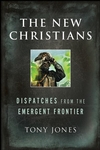
Book Review: The New Christians
I just finished reading Tony Jones' latest book, The New Christians: Dispatches from the Emergent Frontier, and I have to say that it is hands down the best book to read for a basic and yet thorough description of what the emerging church (and especially the Emergent Village influenced part of it) is all about. I resonated with nearly everything Tony said about what motivates us "emergents" and how we tend to think about things. He put these in the form of 20 short "dispatches". These are:

  1. Emergents find little importance in the discrete differences between different flavors of Christianity. Instead, they practice a generous orthodoxy that appreciates the contributions of all Christian movements.
  2. Emergents reject the politics and theologies of left versus right. Seeing both sides as a remnant of modernity, they look forward to a more complex reality.
  3. The gospel is like lava: no matter how much crust has formed over it, it will always find a weak point and burst through.
  4. The emergent phenomenon began in the late 1990's when a group of Christian leaders began a conversation about how postmodernism was affecting the faith.
  5. The emergent movement is not exclusively North American; it is growing around the globe.
  6. Emergents see God's activity in all aspects of culture and reject the sacred-secular divide.
  7. Emergents believe that an envelope of friendship and reconciliation must surround all debates about doctrine and dogma.
  8. Emergents find the biblical call to community more compelling than the democratic call to individual rights. The challenge lies in being faithful to both ideals.
  9. The emergent movement is robustly theological; the conviction is that theology and practice are inextricably related, and each invariably informs the other.
  10. Emergents believe that theology is local, conversational, and temporary. To be faithful to the theological giants of the past, emergents endeavor to continue their theological dialogue.
  11. Emergents believe that awareness of our relative position - to God, to one another, and to history - breeds biblical humility, not relativistic apathy.
  12. Emergents embrace the whole Bible, the glory and the pathos.
  13. Emergents believe that truth, like God, cannot be definitively articulated by finite human beings.
  14. Emergents embrace paradox, especially those that are core components of the Christian story.
  15. Emergents hold to a hope-filled eschatology: it was good news when Jesus came the first time, and it will be good news when he returns.
  16. Emergents believe that church should function more like an open-source network and less like a hierarchy or a bureaucracy.
  17. Emergents start new churches to save their own faith, not necessarily as an outreach strategy.
  18. Emergents firmly hold that God's Spirit - not their own efforts - is responsible for good in the world. The human task is to cooperate with God in what God is already doing.
  19. Emergents downplay - or outright reject - the differences between clergy and laity.
  20. Emergents believe that church should be just as beautiful and messy as life.

I have to confess that I fit pretty much all of these descriptors. This is very much my own journey too. I think Tony has captured where a lot of us are at. And he embeds these dispatches within a narrative of where the emerging church came from and how it evolved, along with many other first hand stories and anecdotes of people and churches on the emerging journey. This is Tony's strength as both the National Coordinator of Emergent Village (a semi-formal network/friendship among some of the original influencers of the emergent movement, as well as many others like myself who have found it to be a welcoming tribe and a help to my own journey), and as one of the people who has been intimately involved with the emerging church since the beginning. He gives us the insider's view, and isn't afraid to talk about specifics and name names.

However, one concern I had with the book is that he may be making his statements too broadly and too definitively. While these 20 statements may be true of me, I'm not sure they're are true of all emergents. Tony might have done better to adopt the strategy that many others have used of identifying various "streams" of the emergent movement, and acknowledging that different people are at different points depending on which stream they stand mostly in. (For instance I have identified three streams, Scot McKnight notes five, and Brian McLaren has seven.) I suspect that Tony's description probably does resonate the most with those who identify most closely with Emergent Village and the theological, philosophical, and political conversations typical of that stream of the emerging church. While not entirely neglecting them, he does give significantly less attention to the discussion about worship styles found among folks like Dan Kimball and the British-based alt.worship crowd, or to the structural discussion about "missional" and "organic" churches typified by Alan Hirsch, Spencer Burke, and the rest. I'm not sure if that was deliberate or not. Perhaps Tony felt like his task was to describe his particular stream and simply chose to leave these other streams for others to comment on, but if that's the case, he never quite makes that clear.

I did appreciate that Tony balanced his description to show how emergents are dissatisfied with both the right and the left in American Protestantism. It is well-known that emergents are often critical of conservative evangelicalism, but Tony gives at least as much airtime to emergent complaints against mainline bureaucracy and dogmatic liberalism. Ironically, I've already started hearing from some mainliners who seem shocked at Tony's criticisms of them. As long as we were moving away from conservative Christianity, that was fine, but I wonder if they actually thought it was just a matter of time before we landed in the mainline churches, not realizing that the emerging critique has just as much to do with restrictive church structures as it does with restrictive church dogma. I guess no one likes it when you start trying to barbecue their particular sacred cow.

However, another critique I have of Tony's approach to describing the emergent movement is that much of the time it felt too much focused on how emergents are critical of the rest of the church, and not enough about how we are also generously orthodox and strive to include multiple traditions and streams of faith. That's not to say Tony doesn't mention this at all, he does, but that's not the tone that comes across throughout most of the book. I remember when Doug Pagitt was down here in Chicago speaking to our up/rooted cohort and I asked him how his emerging church, Solomon's Porch (which Tony also attends and describes in the book) was different than other churches. I liked that he refused to answer that question, and instead told that they prefer to think about how the Porch is "kinda like" a lot of other churches (kinda anabaptist, kinda liturgical, kinda evangelical, etc...). I would have liked a little more of this attitude in Tony's book. The emerging church is not merely a movement away from something (though of course that is part of it), but it is also a convergence of a lot of different things that have been bubbling up in many different corners of the church. To fully describe the emergent movement you also have to talk about what it is that we are rediscovering and embracing in the storehouse of the church's great traditions. Instead I felt like Tony was constantly trying to set up a contrast between the emergent movement and what we are emerging from. (Though, to be fair, perhaps he felt like Brian McLaren already covered the first topic sufficiently in A Generous Orthodoxy, and besides which, Tony has never been one to shy away from a good debate, so it doesn't surprise me that he wouldn't pull any punches in this book.)

Nonetheless, overall I still think this is an excellent book and definitely the one to give to someone who wants a basic introduction to the emerging church. As long as you can handle the fact that the emergent movement does offer a critique of the existing church, and therefore may at times critique something from your particular branch of it (whether on the right or left), you should be able to appreciate the concerns that motivate and describe many emergents like myself that Tony so ably highlights.

Labels: book reviews, emerging church, Tony Jones

 
posted by Mike Clawson at 11:41 PM | Permalink | 0 comments
Layout design by Pannasmontata Header image © VladStudio