Emerging Pensees
thoughts on God, faith, life, and the emerging church... btw, "pensees" is French for thoughts. get your mind out of the gutter ;)
about


Name: Mike Clawson
From: Austin, Texas, United States
About me: A follower of the way of Christ, a "postmodern" Christian, an amateur theologian/ philosopher, a husband, a father, a student, a friend...
More..
Contact: mike(dot)clawson
(at)gmail(dot)com


My Facebook Profile:
http://www.facebook.com/ mike.clawson1
Blog Categories
  • - atheism
  • - book reviews
  • - emerging church
  • - Emma
  • - Aidan
  • - fun
  • - personal
  • - politics
  • - social justice
  • - theology
Brian McLaren on Plato & Aristotle Yeah, but he didn't link to the CHB site!

LOL

If your readers are interested, Mike, I did post a follow-up to Brian's response on Friday.
Citations I think you should link to Jonathan Brink's reviews as well (even though they are still in progress). I haven't seen them Josh. Do you have a link? http://jonathanbrink.com/2010/02/25/a-new-kind-of-christianity-initial-thoughts/

http://jonathanbrink.com/2010/02/26/a-new-kind-of-christianity-book-review-question-1/

http://jonathanbrink.com/2010/03/02/a-new-kind-of-christianity-%e2%80%93-book-review-question-2-3/

http://jonathanbrink.com/2010/03/09/a-new-kind-of-christianity-%e2%80%93-book-review-question-4-5/
Thanks! I sure wish I could be on the list of those who have read the book. It has been twice promised to me for review (and thus canceling order from Amazon), but it never arrived. Anyway, hope mine wasn't one that made you angry!

Peace,
Jamie
No Jamie, your post didn't anger me at all. I think I just found it slightly amusing, and somewhat disheartening, that there were actually several people who decided to speak out on the book (or the controversy surrounding it) without any actual first-hand knowledge of it. I'm used to those opposed to the emerging church merely reading what the critics say rather than the primary sources, and basing their opposition solely on that (the senior pastor of the church I got kicked out of, for instance, who would only read DA Carson's book, but not McLaren himself before forming his opinion), but I guess it just surprised me when a couple of folks friendly to the conversation (you and Bro. Maynard) basically adopted the same approach.

Anyhow, I hope you manage to get your hands on a copy soon so you can see what you're missing out on!

Peace,
-Mike
Brian McLaren Clarifies Some Questions About ANKoC: Part IV Mike,

First of all, thanks for posting this interview--it's been handy to see where folks have been taking McLaren differently from how McLaren takes McLaren.

I suspect your answer is "Wait until installment 5," but did you ask him at any point why he saddled Plato and Aristotle his "six-line narrative"?

Incidentally, I do see some tension with his occasional disdain for seminarians and traditions of theological inquiry on one hand and his insistence that his critique is aimed at televangelists on the other. Seems to me that the answer to public ignorance of complex inquiries should be systemic programs of education, but when those folks who dedicate their lives to such pursuits are "prison guards" in one of ANKoC's interludes, it's hard to see the book as friendly to the pursuit.
Hey Nathan,

Unfortunately there isn't going to be a Part 5. I did actually consider raising that question with him, but the more I thought about it the more I realized that it's really more your concern than mine. I agree that Brian oversimplified the history of Greek philosophy, but I don't think he got it as wrong as you imply that he did. Maybe I'm just reading him differently, but I didn't see him actually laying it all at the feet of Plato and Aristotle, but just trying the describe the general milieu of Greek philosophy in the early centuries of the church. It seems undeniable to me that certain strains of Greek thought were in fact rather dualistic re: matter/spirit, etc. (Neo-Platonism? Manicheaism?) and that some of these attitudes did in fact seep into the church. And Brian did acknowledge in his footnotes the greater complexity.

At any rate, I guess I'm just not as worked up over it as you are, and didn't feel the need to pursue it with Brian. I'd be very interested to hear him engage with you criticisms, but I don't feel they really detract from his overall point (which is that, wherever it came from, this narrative does exist in the church, and that not all of it comes from a Jewish/biblical view of the world), and that is really what I am more concerned with.

If you want to put your concerns in the form of a succinct question though, I could see if Brian would be up for responding to it. Or I could see if he wants to do it over at your blog.

As for the seminary thing, I think again, I'm just reading Brian differently. I didn't see him trashing the value of any and all seminary education. I think he does value that, but at the same time, I think he also rightly points out that there can be problems with it too. I think we'd all have to admit that whatever the positives of higher education are, that it can also at times create some significant blind-spots and/or power-plays that empower certain theological gatekeepers and prevent the circulation of new ideas - especially within the far more restrictive world of evangelical seminaries (which I suspect Brian primarily had in mind).
I suppose you're right that, as someone who's spent the last three years teaching Plato and Aristotle to undergrads, I probably do have more invested in getting them right. (Incidentally, my new college has given me the green light to reinstate that course as part of their new honors program.) For what it's worth, I'm sure you remember times when I've gotten similarly irked when people laid stupid assertions at the feet of Derrida over at theooze.com. I still maintain that there's no particularly good reason to reduce Greek philosophy to a monolith any more than there's good reason to reduce postmodernism or the Enlightenment or any other complex array of phenomena, but I do tend to be fussy that way.

I will agree, though, that folks who know McLaren personally and folks with an axe to grind have been reading this new book very differently than I have. :)
I definitely appreciate your passion for academic accuracy Nathan. And while I have read a lot of Plato and Aristotle (among other Greek philosophers), I'm certainly not as well versed as you are and have to defer to your expertise on whether or not Brian represents them fairly or not.

However, I did just go back to re-read your initial review of ANKoC and in response to your concerns I think what I would say is that (as I read Brian) I'm pretty sure that by the term "Greco-Roman Narrative" Brian was not intending to represent what any particular Greco-Roman philosopher thought or taught. I think he was in fact using the term "Greco-Roman Narrative" to designate a later syncretistic combination of Christian/Jewish beliefs, Roman Imperialism, and Greek philosophical ideas (which had their origins in Plato and Aristotle, but may or may not be directly found in them). In other words, what Brian was describing as "Greco-Roman" is neither wholly Greek, nor wholly Roman, but rather how later Christian thinkers took various strands from each of these and recombined and changed them to fit within their own Jewish/Christian narrative (and also how they changed the Jewish/Christian narrative to fit with these other strands).

That's why while I think everything you point out about Plato and Aristotle is correct, ultimately I think it might be besides the point, since it seemed to me that Brian's main point was not to do a strict analysis of Platonic and Aristotelian thought, but rather point out how some of the ideas that originated with them later came to influence Christian thought so as to create a new, third thing.

That's just my take on it anyway.
I see Brian has put up his response to your concerns. Brian McLaren Clarifies Some Questions About ANKoC: Part III Could it still be true that atheists have an important job to do. . .

Woo, hoo!

. . .for some time at least

Grrr...
I'm not actually sure what Brian meant by that particular phrase. I can read it in a couple of different ways. The way that seems most natural to me is that the "some time" is referring to "for as long at theists are still largely in power in our society," and not as "until there aren't any atheists anymore."

I say this because in the book Brian is explicit about saying the goal of Christianity should not be to try and eradicate every other differing belief system out there (including atheism).
I took it to mean that there will come a day when there will no longer be atheists. That is, there will be a day when every knee bows and tongue confesses Jesus is Lord. I was just joking, wasn't trying to make a serious point. :) Hi Mike,

Thanks for asking Brian these questions! I really appreciate his response here. I think that many of us are wanting to live a faith that's both deeply biblical and yet expansively responsive to the 'new universe story' as told by Thomas Berry, Brian Swimme, Michael Dowd and others.

On another note - gasp! Brian, are you saying that you actually believe in the Trinity?? You lie! :)
Great stuff. My 17 year old son has recently proclaimed that he is an atheist and it is the best thing that has happened to our spiritual life. We now talk several hours a week about the nature of man, how people can help others, how exactly does God work through people and if there is a mechanism outside of God, what is wrong with current day Christianity (his primary problem with Christianity, by the way, is that he hates the way Christians behave so by their fruit he no longer believes in Jesus). I think his atheism has more power and love than most Christianity I see.
Of course none of that means anything if your core belief is that you have to "believe in Jesus" to be saved....

Dave
Brian McLaren Clarifies Some Questions About ANKoC: Part II Thanks, Brian, for this response.

Here at Duke Div where I am in seminary I surprised to find that the "conservative vs. liberal" conversation isn't even on the table anymore. Circles I run in here don't think in these dualist categories (or at least are trying hard not to). I've been impressed with that and have been hoping that sort of ethos gathers steam. Hopefully your book and responses like this will move us further towards that.

as a side note, I would just say that contrary to popular opinion (you hint at this in your book and Theology after Google along with Tony Jones certainly say it) there are SOME seminaries that do not teach a constitutional view of the Bible nor are they caught up in this 6 line narrative. And many are very much committed to being in service to the Church rather than the Academy. At least my experience at Duke has been such.

c
Absolutely love the comment about liberalism and conservatism. I find myself in the same position - too liberal for some, too conservative for others. Brian's comments hit the nail on the head and with him I completely concur. God bless you Brian! I have experienced much the same thing here at Austin Presbyterian Theological Seminary, Chad. There is a lot of diversity among the students, not strictly liberal or conservative, though some of each (for instance I have classmates who are Southern Baptists, Assemblies of God, United Methodists, Catholics, and even Unitarian/Universalists, right along with all the mainline Presbyterians). And like Duke, the faculty do not teach a constitutional view of the Bible, nor do they teach the 6-line narrative. Places like this do give me hope. Brian McLaren Clarifies Some Questions About ANKoC: Part I Brian, thank you for clarifying some of these important themes and thank you, Mike, for providing a format to do so.

I have been amazed by the amount of misinformation floating around about this book. It tells me at least 2 things: One, many are predisposed to hate it and can't for the life of them read with the charity and grace they claim saved them and two, those in the middle are reading some critiques (and critiques ONLY) and coming away with warped ideas about what this book is trying to say (I'm thinking about Scot McKnight's review about "The Evolving God" which I deal with on my blog).

This is a great way to sort some of that out (I hope!) I'll direct people here.

peace,
Chad
Thanks Brian and Mike for this! I've been reading "Naked Now" for a few weeks now (it's so deep, it requires slow reading and reflection), and will start Brian's book after my class is over.

Looking forward to seeing you (Brian) at my school next Friday (Moravian Seminary).
As one who agrees with the bulk of what Brian writes, I can say that one of the things I've had the most problem with is giving the impression that these ideas are new, implicit in the title of ANKOC and A New Kind of Christian before it. I realize there are acknowledgments of the wisdom that has come before in many places in his writings, but still there's an overall impression that grates.

It's good he here explicitly acknowledges that many in earlier generations have gotten the main points. However, there still is a flavor of "we've got it better than those who went before" in his describing the history of Christianity as one of growth.

Brian is a naturally optimistic person, and I suspect that's partly why he portrays it this way. But I don't think the analogy to scientific progress is a good one.

The real truth seems to me is that we take steps backward and forward, and in every generation there are Christians with different approaches. I'm not a church historian, but I question whether a thesis of linear growth in understanding can be substantiated. And it winds up having an air of arrogance, even though I know Brian is not an arrogant person.
Book Review: McLaren's A New Kind of Christianity Mike - I'm reading the book myself and am soooooo glad to read your review. I was beginning to think that I maybe I had gone off the deep end because #1 I haven't been shocked by what Brian has written and #2 I agree with a lot of what he is saying.

However, I would like to say that even if I disagreed with Brian I would never say things that I have been hearing some say about and to Brian...it just seems like a very poor way to demonstrate the way of Jesus.
Why does McLaren on the one hand want to get back to "more historically authentic Hebraic" lenses to view the Bible, but then on the other hand - in relation to the OT's depiction of God's violence - want to paint these early Hebraic lenses as insufficient? In light of "he realized that he couldn't get the crowd to discuss the things he was really passionate about (i.e. the four global crises he addresses in EMC) because all people wanted to talk about were his controversial theological ideas," it seems kind of silly to keep carrying the theology around. While I'll admit that the attempts to reinterpret the parts of the Bible that make God appear somewhere on the jerk-to-monster portion of the personality spectrum are often insanely clever, I'd think that those who are primarily interested in solving real-world problems like poverty would eventually just give up on the reinterpretation and chuck the Bible. Mike, thanks for taking the time to apply your analytical brain to this book. I'll admit, there was a time in my life that whenever someone mentioned a new theologian to me, I searched your blog first to see what you thought of him or her. :-)

I really like what Bradm is asking. Do you have a thought? My impulse (as someone who engages fairly regularly with Hebraic lenses AND their modern manifestations) is to say that if we go back that far, we can reconstruct a new trajectory for the Christian faith based on the paths of minority voices that lands us in this "new" kind of Christianity. Kind of like going back to where you last saw your keys in order to find them again.

Miko, I would say that for some of us, there is a super-natural force tugging at our souls, keeping us tied to spiritual communities and the scripture that forms them. I wish I could be so pragmatic as to chuck the Bible but there would be a big hole in my life if I did. I know that this is not he case for everyone and there are plenty of secular folks who have done just that in order to better work for justice.
Bradm - Rebecca (i.e. Princess Max) has hit on it. Brian is suggesting that we read the biblical narrative as a trajectory, a conversation, and a progressive unfolding of God's self-revelation, so that we look through Hebraic lens not to simply re-appropriate ever stage of the journey, but to see the direction of the trajectory that leads up to Christ.

I also agree with Rebecca that if we want to follow the ongoing trajectory since Christ, it might be worthwhile to go back through church history and look at it not through the conventional lenses of the power players (i.e. Popes, Emperors, major theologians, dominant institutions, etc.) but through the "minority report" of subversive and Spirit-filled movements (e.g. the monastics, Franciscans, mystics, Anabaptists, etc.)

Miko - again I second what Rebecca said. Brian doesn't simply chuck religion because he recognizes that for many people it is still a very powerful force, and he is more interested in harnessing that force for good than simply trying to work against it or in spite of it. For instance, in Everything Must Change he doesn't just deal with the crises of poverty, the environment, and violence, he also frames these in terms of an overarching "spiritual" crisis in which we have collectively lost our ability to imagine a better way and a better future.
Bradm, Mike also has a longer answer to that question to that in a previous blog post that I found pretty interesting:

http://emergingpensees.blogspot.com/2007/03/how-to-read-bible.html

BTW, Mike, in IE8 the movies in the right sidebar of your blog are messed up - they float off to the right, out of the sidebar.
Thanks AH - I haven't used IE in so long I guess I didn't even notice. I'll see about fixing that :) best review of it yet! mike morrell has now been moved down to second. Really great review. And I deeply appreciate you pointing out that he hasn't discovered some "new" Christianity, but that it's been around for ages and ages, and that he's not some crazy liberal.

I'm a crazy liberal, and I know crazy liberals, and B-Mac is no crazy liberal. :)

I think what he has to say is groundbreaking for a lot of evangelicals, and that's fine, but the mainliners out there are reading his stuff and saying, "and...?"

I thought this was wonderfully thorough, appropriately critical and ground in something greater than the nauseating evangelical v. emergent bickering so common for these reviews.

Well done and thank you.
Thanks David.

And I do think Brian has a word for liberals too. Compared to much of the liberal theology I've encountered, Brian is definitely a "third-way" between evangelicalism and classic liberalism. Both sides could stand to learn something from him and the synthesis he provides.
Mike,

I'd love to hear your thoughts on RJS' latest post at Scot's blog - basically indicating that Brian's view of the gospel is not wrong but not deep enough:

http://blog.beliefnet.com/jesuscreed/2010/03/nt-wright-on-genesis.html
Hi, Mike. I was confused when I heard you writing about ANKOC & now I understand. I appreciate much of this. One thing that stuck out:
"that the violence of God in the Bible should be understood as earlier and insufficent understandings of God ... which ultimately culminates in the Divine Incarnation in Jesus, through whom we need to completely rethink our view of God;"
Yes, but what about all the violence in Revelation? For me, it is unsatisfying to try to make the case that God is never violent (even against evil? what about justice?), but that (a) God is patient & wants the best of us, (b) God alone is perfectly just & His violence is just and (c) I am not God and have no business taking things His domain into my hands. I need to follow Jesus and let God be God.

Also, as a computer guy, I liked the Ubuntu reference. Microsoft and Apple are bastions of top-down control, and versions of Linux like Ubuntu are all about freedom & "power to the people". Like Enc. Britannica vs. Wikipedia, but with software. So all your pomo friends should start using Ubuntu now. ;-) (I wouldn't be surprised if many of them have already picked up on this.)
Interestingly enough Joel, Brian actually directly deals with those passages in Revelation in his discussion of whether or not God is violent. He suggests an alternative reading of Revelation that takes into account it's metaphorical/symbolic nature, and suggest that those who see it as a prediction or sanction of divine violence are in fact missing the point.

I'd really recommend reading the book for yourself to see if you like how Brian develops this thesis. I'd also highly, HIGHLY recommend another book by New Testament scholar Brian Blount entitled Can I Get a Witness? Reading Revelation through African American Culture for an even better discussion of whether Revelation actually supports an ideology of power and violence or in fact undermines and critiques it.
One other point I wanted to make is that when we talk about God's "violence" or justice against evil, it's important to remember Paul's statement that "our struggle is not against flesh and blood, but against the powers, principalities, etc...". In other words, God's does in fact work against the powers and systems of evil in this world, but in a way that brings freedom, not violence, to the actual flesh and blood human beings caught up in that evil. As Greg Boyd paraphrases, "if it has flesh and blood, it's not your enemy," and I don't think it's God's enemy either. Great review Mike! Very thoughtful and thorough and as unbiased as one should expect. Thanks for taking the time to address other critics' concerns as well. You've definitely gotten me interested enough to actually get the book. ' he hasn't discovered some "new" Christianity" '

No, it would be an old heresy.

You guys re stuck in seminary/Starbucks wannabe-ism. Have fun in your mainline churches when you are too old to continue wearing goatees.
" I wish I could be so pragmatic as to chuck the Bible ..."

And this receives a pat on the back. Nuff said. You guys are self-worshippers, not God-worshippers. Anderson Cooper should be your prophet. Hate to be so shrill, but since you are determined to explain away anything you find primitive, lets just call you the modernists you are. Just because you know people far more liberal than yourselves, does not mean you are not ragingly liberal in your essence. And yes, I mean that as a bad thing. You make the New Calvinists look like good scientists.
thanks for the hate brother. not sure what you hoped to accomplish by posting that here, but I hope it made you feel better.

peace
Religionless Christianity and the Emerging Church Very nicely done. Summarizing the five things Bonhoeffer saw as religious negatives:
Religion privatizes God, causing the religious person to become preoccupied with self.
Religion insulates the believer, separating God metaphysically from the world.
Religion is provincial, occupying an ever diminishing territorial sphere of influence.
Religion deus ex machine, the believer plays God thus making God seem superfluous.
Religion creates a privileged class uniquely blessed or better.

Makes me want to go re-read Cost of Discipleship - Mike which of Bonhoeffer's books would you recommend - or would you recommend going straight to Rollins?
If you want to read Bonhoeffer, I'd recommend his Letters and Papers from Prison. For Rollins, I'd start with How (Not) to Speak of God. Very nicely done, Mike. Thanks for sharing it with us. It's a great resource.

How is Bonhoeffer viewed by the larger Christian community? Is he considered a heretic or does this connection potentially lend some authority to emergence for those who need that sort of thing?

Also, I have to admit that you lost me with Finding God in the midst of life also means, however, that God is present in our weaknesses and sufferings. Bonhoeffer’s non-religious interpretation is a theologia crucis insofar as the God who is found in the totality of life is also found on the cross. (Bethge 1967, 81) It is only in God’s powerlessness and suffering, not in omnipotence or control, that God can help us.
The jump from weaknesses and sufferings to Christ wasn't obvious although after reading it through several times, I think I get it. Maybe it's 'cause I don't know that fancy Latin. :-)

Finally, you know I love a shout-out and this Presbyterian who celebrates jazz vespers was grinning when she read that part.

Hope your new year is good. Thanks, again. I'll direct people here often, I suspect.
PrincessMax, for mainline Protestant scholars and seminarians, Bonhoeffer stands as one of the most significant voices of the 20th century, a hero of the faith for pushing the boundaries of our safe understandings of what it means to be the church.
Mike, this is a great paper; I remember loving my Bonhoeffer seminar at Andover Newton.
I'm a UCC pastor, and I've found people in the churches I've served already understand the idea of God with us in our sufferings and particularly grasp the idea that the church exists to serve in the world, not to be set apart from it. How could it not be our purpose?
But I'll grant that churches with a long history have a challenge in overcoming the baggage of buildings and traditions that sit alongside their understanding of the social gospel rather uncomfortably.
Hey Rebecca, sorry it's taken me a while to respond to your questions. Even when I'm not in school I still can't seem to find the time for blogging these days.

Anyhow, Songbird said, Bonhoeffer is very popular among mainliners. However, perhaps surprisingly, he is also very popular among evangelicals as well. I read him in my classes at Wheaton. (After reading him more closely at my mainline Presbyterian seminary, however, I'm convinced that most evangelicals don't actually grasp the theological context or the full implications of what Bonhoeffer was really saying most of the time, and fail to realize that he wasn't actually one of them.) At any rate, yes, I think Bonhoeffer could be used as a bridge between emergents and evangelicals (and between evangelicals and mainliners), though unforunately these themes of "religionless Christianity" are very brief, and only begin to appear in his later prison letters. He never had time to fully flesh them out, so it'd probably be pretty easy for most evangelicals to just dismiss or ignore those parts they don't like and only focus on the bits that already resonate with their perspectives. (Actually, it's pretty easy for anyone to do that with Bonhoeffer, since his theology was in constant flux throughout his life and he often ends up contradicting himself in later writings.)

As for clarifying the bit about weakness and suffering, I have to apologize since I was severely limited on my word-count (the paper could be no more than 2500 words), so I was forced to condense all of my points and not really elaborate on any of them. As a result I think some of them are less than clear, especially for folks not already familiar with Bonhoeffer's writings. Anyhow, "theologia crucis" simply means "Theology of the Cross" (though I'm sure you were able to figure that out), and refers to the fact that Bonhoeffer, like his major influence Karl Barth, is radically Christological in his theology and especially in his conception of God. In other words, Bonhoeffer thinks that we need to understand God through the lens of the Incarnation of Jesus Christ. By doing that we come to see God not as a God of power and control, but a God of weakness and self-sacrifice. And it's not just that God is weak and sacrificial for a little while, while Jesus was here on earth, but all the time - it is an essential and eternal part of who God is. The incarnation and the cross reveal God to us - reveal God as Immanuel, "God with us", in all our human strengths and goodness, as well as in all our sufferings and weaknesses too.

Does that help?
Brian McLaren in Austin Why Vote? Mike, I've been reading your blog for awhile and enjoy your perspective on life and living. I wrote a post on my blog a few weeks ago about how I couldn't understand why someone would consider not voting. Voting is not an inherent right -- had I lived in this country 100 years ago, I wouldn't have had that right. My predecessors in women's rights fought for decades and generations for that right against strong opposition. Coincidentally, some of the opposition was supported by Christian teaching of the day. So I vote because I don't want to lose this right. I wonder if people would throw away the right so easily if they thought they might lose it. Welcome Heather.

I agree. The fact that millions of people have been and/or continue to be disenfranchised makes exercising my right to vote all the more important. People are fighting and dying in some parts of the world for the right to have a say in their own governance, so it seems insensitive and even arrogant of me to choose to throw my own vote away based on some religious notion of "purity".
Brian McLaren in the Washington Post Everything Must Change Tour recap Mike, how did Brian relate decreased mainline church attendance to increased college attendance rates? I've never heard that one before. Brian was citing a sociological study done (by Robert Wuthnow maybe?) which showed that the decline of mainline denominations began around the same time that their rates of college attendance increased. Whenever people leave home to go to school, a certain percentage of them will not find a new church. And then when the move again 4 years later, another percentage will drop out of church. Plus college educated people statistically delay marriage and having children, which is another factor in people not returning to church. Apparently this study showed that these statistical losses due to people going off to college and not returning home afterwards, and then also delaying marriage and children were more than enough to account for the losses seen by mainline churches in the past 30-40 years.

Interestingly, this same study also pointed out that evangelical college attendance rates are just now at the same level that mainline churches were 30 years ago when their decline began. If those trends hold it will be interesting to see if the same thing happens to them.
OK, that must have come from Wuthnow's recent book on post-Boomer generations and American religion. Wuthnow does make some observations to that effect, among others.

Having spent time in both evangelicalism and the mainline, I'd venture to say that there's a lot more going on with regard to the mainline's decline than greater college attendance, lower birth rates and later marriage ages though. It's not as simplistic as some evangelicals would like it to be, but neither do I think it is just a matter of demographics as Wuthnow borders on suggesting.

I'm sure the mainline folks are ecstatic at those parts of Wuthnow's book. While I was in the mainline it was part and parcel of every large regional gathering to hear reassurances that declining membership and attendance figures, constant budget shortfalls and staffing and program cutbacks, had nothing whatsoever to do with the denomination's theological and political direction. They will be thrilled to have further ammo to argue that in fact those things have happened precisely BECAUSE they are smarter, better educated, and more right, than evangelicals.
Karl, I think you heard those things at the conferences you attended because those are exactly the accusations that evangelicals like to level at the mainline to explain their decline. I remember hearing it in my conservative evangelical churches growing up, even before I had a clear idea of the differences between mainline and evangelicals. The narrative they liked to put forward was that "those mainliners" went liberal in their theology, and started caring about social justice, and oh yeah, they were also tied to dead ritualism, and that was why they were declining. That was the story that got told, whether they had any proof of it or not. So I can see why mainliners might be a little defensive about it.

However, even if there is any truth in it, it seems to me that the decline of the mainline and concurrent growth of evangelicalism could just be an example of people following whatever their "itching ears" want to hear. What's more appealing to people? A social gospel that implies that you might actually have to change you lifestyle and dedicate yourself to fighting against enormous systems of injustice? Or an emotional-high, Jesus-as-my-boyfriend, pray a prayer and get a free ticket into Heaven when you die religion? And what is easier for the average church-goer to handle, a nuanced, non-literalistic, and historically contextualized reading of scripture? Or a "God said, I believe it, that settles it" approach?

It may be condescending for mainliners to claim that they've declined because "they are smarter, better educated, and more right, than evangelicals", but that doesn't mean it isn't true.
Wow Mike, talk about setting up a straw man. I realize that in this case the straw man actually exists - that there are some evangelicals who would articulate it that way and you probably did hear it that way growing up. But you aren't engaging with the best evangelical critiques of the mainline.

IMO, someone with your level of education should be dealing with the best and most thoughtful of what evangelicalism has to offer on this topic when contrasting evangelicalism with the views of scholars favorable to the mainline. If you want to trash evangelicalism, critique not just the Baptist pastor down the road or the church in which you grew up, but Alister McGrath and John Stott, Mark Noll and Dallas Willard and Richard Foster. I don't think any of them would own the opinions that you just attributed to evangelicals, but they'd all be critical of mainline theology, in varying degrees.

My observation of the mainline denomination I lived in for 5+ years was that its leadershp's narrative was too tepid and relativistic to make much of a claim on anyone. The criteria for being a good mainliner were indistinguishable from those of being a good member of any local volunteer social service organization like the Kiwanis, but it took a lot more time and expense because you had to maintain all the trappings of a religion around it. The problem wasn't the addition (or reclamation) of social action as an essential part of Christian commitment, devotion and mission; it was the reduction of Christian commitment, devotion and mission to solely social action. We just exchanged one set of problems and arrogances and self-righteousnesses for another.

Anecdotally, I know many evangelical college students and 20 somethings are leaving the evangelical church. But almost all evangelical churches I've interacted with have SOME college students and SOME college educated 20-something singles or college educated young couples w/o kids. Not nearly as many as they'd like to have, but at least some. In the mainline churches I encountered there were often none or nearly none in those demographics who attended regularly. So while Evangelicalism is subject to the same demographic trends, the mainline seems even more vulnerable to them. There's something going on beyond the mere demographics.
Karl, I'm not interacting with the so-called "best" of evangelicalism because frankly that's not what we're talking about here. It's all well and good for you to whip out Willard, McGrath, Noll, or whoever (all of whom I still have serious disagreements with) but what percentage of the average evangelical church goer has any clue about those guys? How many evangelical churches do you suppose actually reflect that sort of evangelicalism? In my experience your "best" of evangelicalism is the exception in evangelical churches and even among evangelical pastors and leader, not the rule. My point was about broad trends among the average evangelical churchgoer, not about that small, isolated handful that have read the more thoughtful evangelical scholars. If I had characterized the mainstream of evangelicalism as being at all similar to the kind reflected by Foster or Stott or the rest, it would have been highly inaccurate. Like it or not, the average evangelical churchgoer as far as I can tell (and I'm pretty sure the stats per Barna or whoever would back me up on this) is more or less as I've described.

At any rate, I'm sure there are lots of reasons for the decline of the mainline churches and it can't just be reduced to one factor, however, on the other hand I don't think it's really as a bad thing as you apparently do that they've focused more intently on social action as a way of living out the gospel. Frankly, I'd love to be in a church (besides the one I've created myself) where that was even part of the discussion.

Karl, you're obviously still a big fan of evangelicalism, and that's fine; but personally I too was immersed in your so-called "best" and it still wasn't enough for me. I read Stott and Noll and McGrath and Foster and Willard and all the rest, and frankly if that was really the best Christianity had to offer then I honestly don't think I could have stuck with Christianity much past college. But surely you felt a little bit of that too? You must have seen something of value in the mainline churches that you weren't finding in evangelicalism if you existed there for 5 years? So why only trash them all the time as you do here on my blog, and then also constantly try to defend evangelicalism and look at it only through the rose-colored glasses of your so-called "best"?
Good comments here Mike. I'm glad you posted your thoughts - similar in many ways to how I felt about the Dallas stop. I'm especially glad you had such a great response of people who are interested in the cohorts. Mike I'll take your previous requests for dialogue from those who disagree with you at face value and respond as if you really are posing those questions as invitations to conversation. But that means this'll be another long post. What I'm saying is that I found the on the ground reality of the American mainline to be every bit as messy and ugly and sinful and truncated and reductionistic and coercive and marginalizing of disagreement, and just flat out harmfully wrong on some really important things, as the on the ground reality of evangelicalism, if not more so. Just in different ways. I also witnessed firsthand the flight (and near-total absence) of teens and twenty-somethings from the mainline church to a degree that I'd never seen in evangelicalism.

Further, I guess I'm saying that I found I'll take the articulated ideal picture of evangelical faith and practice as set forth by McGrath, Stott, Willard, Richard Foster et al. over the articulated ideal of mainline faith and practice as set forth by mainline leadership. I'd follow John Stott or Alister McGrath or N.T. Wright or Richard Foster before I'd follow bishop Jefferts-Schori (her being a woman has nothing to do with it) or John Spong.

I left evangelicalism for a time not for primarily theoretical or theological reasons (though there were a few of those around the edges), but for the failure of evangelicalism as I was experiencing it to live up to its ideals. The mainline was attractive to me because I was reacting against the deficiencies and abuses of my particular evangelical church and (to a lesser extent) of most of American evangelicalism as you've described it, and found the absence of those things (and the presence of some things I was longing for) to be refreshing.

What I found though, was that no movement or organization lives up to its ideals so it's better to pick the one with the ideals that most match your understanding of scripture and go with it, even if it's doing a not so great job of living it out.

I'd still have a hard time being in a doctrinaire evangelical church that defined everything doctrinally to the nth degree, or that didn't make social action/outreach an important part of its ministry. If I was forced to choose between that kind of church and a typical mainline church honestly I'd probably just stay home or start a church like you did. I'm in an evangelical Anglican church whose parent church left the mainline some years back. We left the ECUSA church we were in to come here. It isn't perfect. But it's a good blend of many of the things I was hungering for, even if there are some people, even in leadership, who have blind spots typical of evangelicals.

You've made abundantly clear that you have disagreement bordering on disdain for even the best that evangelicalism has to offer and wouldn't be a part of evangelicalism even if it looked exactly as John Stott, Dallas Willard or Alister McGrath would articulate it. That's fine; I'm not trying to convince you to be evangelical even if I push from (and occasionally for) an evangelical point of view. It's valid for you to criticize evangelical practice on the ground, too. But when comparing evangelicalism to an articulated, theoretical ideal, then to be intellectually honest you have to compare like to like. Compare evangelicalism's articulated theoretical ideal to yours. You are certainly equipped to do that, and have done it well at times. For example, when you posted about Keller's comments and where you were encouraged by his words and where you disagreed.
Karl, sorry it's taken me so long to reply to your comment. Thanks for sharing a bit of your history with me. It was an honest question.

"Further, I guess I'm saying that I found I'll take the articulated ideal picture of evangelical faith and practice as set forth by McGrath, Stott, Willard, Richard Foster et al. over the articulated ideal of mainline faith and practice as set forth by mainline leadership. I'd follow John Stott or Alister McGrath or N.T. Wright or Richard Foster before I'd follow bishop Jefferts-Schori (her being a woman has nothing to do with it) or John Spong."

I'm not sure it's accurate to identify Jefferts-Schori or especially Spong as the "articulated ideal" of the mainline church. Spong especially seems to be on the far fringes even for the mainline. Besides which, I've come to learn that there is just as much diversity within the mainline as there is within evangelicalism. It's not fair, as McLaren puts it, to compare your side's "best" with the other side's "worst". For instance, the Archbishop of Canterbury himself has come out in pretty strong disagreement with Spong. Why not claim him as reflective of the "articulated ideal" of Anglicanism? He would seem a more natural choice than Spong.

"What I found though, was that no movement or organization lives up to its ideals so it's better to pick the one with the ideals that most match your understanding of scripture and go with it, even if it's doing a not so great job of living it out."

Yes, I pretty much agree, which is why I can't be a part of an evangelical church anymore. Even among the so-called "best", I still find that their understanding of scripture and of gospel does not really fit well with mine much anymore.

"But when comparing evangelicalism to an articulated, theoretical ideal, then to be intellectually honest you have to compare like to like. Compare evangelicalism's articulated theoretical ideal to yours."

I usually do. But again, that's not what was being compared here. I wasn't comparing the "ideal" of either side. I was comparing broad sociological trends. I was comparing why large numbers of people were leaving the mainline compared to why large numbers had been attracted to evangelicalism. And I think it's pretty hard to make the case that evangelicalism is attracting so many people because of the influence of its "best" representatives. I think it's far more likely that people are being attracted by consumer impulses like the desire for a good children's or youth ministry or a contemporary worship band, and also by the simple and individualistic message of personal salvation from sin and hell, which will naturally appeal to an individualistic and consumeristic society.

I also don't think we can discount the influence of social conservatism. We may have a chicken and egg dilemma here (did the rise of evangelicalism lead to the rise of social conservatism, or was it vice versa), but nonetheless, I think it makes sense that in an era of intense cultural change like the 1960's & '70s people who oppose that change would flock to churches that reinforce that opposition and abandon those that are trying to adapt to the times. For instance, the church of my childhood switched to the Baptist General Conference from the American Baptist Convention because most of the people in the church disagreed with the progressive social and political positions the ABC was taking. Likewise, how many southern white mainliners do you suppose left their churches for the SBC when the mainline churches started supporting Civil Rights? America on the whole is a fairly conservative society (as evidenced by the political successes of the Religious Right over the past few decades) so it doesn't surprise me that politically conservative churches would have been on the rise, while progressive churches will have diminished.
Mike you make a lot of good points. I'm sure there are sociological factors and a bit of "they're saying what I want to hear - giving the blessing of the church and scripture to my already-held prejudices" at play in both evangelical and mainline attendance numbers. I'm just not convinced those are the only things at play, just like I think sociological factors and "they're saying what I want to hear" have played a role in the growth of the emerging movement, but there's more than that going on as well.

You're right, my view of evangelicalism probably is a little too positive at times. I've seen it at its worst too, but I tend to call "fundamentalist" much of what you would probably call "conservative evangelical." The line between the two gets blurry and groups that might have once proudly worn the label fundamentalist now choose to use evangelical simply because fundamentalist has so many negative connotations (Falwell was one such example). So sometimes we are probably envisioning very different things when we use the term. More on why it may be that way for me below.

As far as the Archbishop of Canterbury representing the ideal of the Anglican church, that's an interesting question. Rowan Williams is a brilliant and devout man, and a bit of an enigma to many including me. N.T. Wright (who would probably be my chosen best representative of Anglicanism as I'd wish it to be) disagrees strongly with Williams about many important things, but respects him greatly and speaks highly of him. But the Archbishop of Canterbury who preceded Williams and stepped down just a few years ago was an evangelical, more in the Stott mode of Anglicanism. So you can't just look to the Archbishop's office and say whoever's there is the center. Jefferts-Schori is theologically to the left of Rowan Williams and in that regard is very similar to her predecessor, Frank Griswold, and to the majority of American bishops. Even if Williams IS the center or articulated ideal of British Anglicanism, Jefferts-Schori more fairly represents where the American Episcopal church is and wants to go. Worldwide, the number of Anglicans in the 3rd World absolutely dwarfs the number of Anglicans in Britain and North America. The Anglicans in those Global South countries are very conservative theologically so if you're looking for a "worldwide average" as the center of Anglicanism, it would look pretty conservative actually. But that doesn't make much difference on the ground in the American branch of that family.

You're right about Spong being an extreme, but I've heard a priest here locally preach a sermon taken right from one of Spong's books, talking about the foolishness of belief in actual miracles, that of course there was no bodily resurrection or virgin birth, etc. After the sermon he then stood and recited the Nicene Creed along with the rest of us. Our bishop, who called on the carpet any priest (and there were only a couple) who didn't toe his line on certain liberal issues, had nothing to say about that sermon. So, just like you might see a direct line from an outspoken extremist like Falwell to a "nicer" conservative evangelical leader with similar beliefs, there are many "nice" mainline leaders who sound moderate and would avoid making controversial public statements but are a lot more like Spong than they'd let on. If forced to make a choice when appointing a priest, they'd take Spong over a fundamentalist (the term they would use) like Alister McGrath or John Stott.

Of course here I'm talking about mainline leadership. The vast majority I encountered in the pews couldn't articulate the difference between any of those folks, and if you tried to articulate it for them they still might not get it. "What's all the fuss about?" Can't we all just get along and agree to disagree? You believe Jesus actually rose from the dead, so teach that. He believes the resurrection is a metaphor invented by the disciples and anyone who believes it actually happened is foolish, so let him teach that. You believe it's a problem that the priest left his wife and moved in with his girlfriend but many of us don't think that has any bearing on his spiritual leadership - he's just following Love, which is the highest law" etc.

I was burned by leadership (and laity) in the mainline in something of a similar way emotionally to how it sounds you were burned in your previous evangelical church. So in talking about the mainline I may come across similar to how you come across talking about evangelicalism - a little bitter. I agree there's lots of diversity there, just as there is in evangelicalism. And lots of good, just as there is in evangelicalism too. But just as you are probably quick to bridle at an overly rosy take on evangelicalism, I am quick to do the same at what seems to me to be a naive or idealistic take on the mainline.

I'm also affected in my view of the mainline by the fact that I grew up in a mainline denomination. Our pastor was a moderate evangelical theologically (conservative for that mainline denomination, moderate/progressive by overall evangelical standards) and our church was one of those "best" types of evangelical churches in many ways - intellectually and socially aware/engaged, high value placed on aesthetics and the arts, the membership was diverse politically rather than homogenously republican, etc. But even in the 70's and 80's I was aware of the undercurrents and theological direction within the denomination's national leadership which finally led that church to leave the denomination a couple of years ago, after decades of trying to stay in.

I'm much more comfortable self-identifying as a Christian than as an evangelical, as I'm not certain I am one anymore at least by some people's definitionn, although that's probably stiill the closest spot on the map for me and I happen to attend an evangelical church. I just don't have the rancor anymore toward evangelicalism that I once did, even if fundamentalists and Truly Reformed zealots still send me quietly out the back door when I see them coming. I jumped ship, saw what the other side was like and returned a bit chastened even though many of my old objections to evangelical spirituality and theology remain.
Well Karl, you obviously have a lot more experience in the mainline church than I do. And it sounds like you've had more negative exposure to the extremes than I've had.

All I know is that for years I was told that all mainliners were as extreme as Bishop Spong and that they all denied the divinity of Christ, the reality of the Resurrection, the inspiration of the Bible, etc., etc. And then when I finally started meeting some mainliners in real life, I found that wasn't actually the case at all. In fact, I have yet to actually meet first hand a mainliner who comes even remotely close to the Spongian extreme. Truth be told, many of the mainliners I meet are more conservative than me in some areas.

And I'm not just talking about lay people. I'm talking about the Bishop of the Metro Chicago ELCA Synod and associate pastors at the gay-friendly ELCA church in Wheaton, multiple PC-USA pastors, the local UCC congregation whose people are both politically progressive and are very passionate about serving their community, Anglican priests who are pulling their churches out of the ECUSA to join the AMIA churches as well as their very devout parishoners who are heartbroken and opposed to this move. In each of these encounters I was very surprised that none of my negative stereotypes of the mainline held true at all. They all loved Jesus, held the Bible in high regard, and didn't seem inclined to disavow talk of miracles.

Perhaps I would see more of the dark side if I was immersed in their churches on a regular basis, but at least on the conversational level I found that I had to give up my assumptions pretty fast.
Mike I think your experience with "real, live" mainline folks is similar to the experience a person would have if she had grown up in a progressive mainline church and had been told over and over that all evangelicals were hate filled bigots like (her opinion of) Falwell, and then moved to NY and visited Tim Keller's Redeemer Pres, or Atlanta and visited Andy Stanley's North Point, or Wheaton (or even, believe it or not, Liberty University) and hung out with a group of students who had just returned from doing inner city ministry. "Hey, on the whole these people aren't the hateful damn-you-to-hell assholes I always thought they were. And even though we may disagree about the best means of alleviating suffering, they aren't as callous and unconcerned about suffering and injustice in the world as I thought, either..." We could all use our stereotypes being broken down a bit I think, and I'm glad you don't have a one-dimensional view of the mainline any more.

I had a similar reaction to yours after first "escaping" evangelicalism for the mainline. Oh, what a relief to be out from that oppressive conservative atmosphere. These mainline people are actually more like me in many ways than most of the doctrinaire jerks I just left behind - much more sophisticated and urbane in their tastes too, which is a plus and helps me feel even more superior to evangelicals. But in the end, at least in our diocese and church, there was one paradigm and one interpretation of scripture that was acceptable on certain issues - and it usually wasn't mine. And the hottest of those issues was pretty much forced upon us - uncovering all sorts of other, more core issues. Actually there was another alternative to agreeing with the majority, but the other alternative was to suck it up and pretend I thought those issues just didn't matter; agree to disagree but keep my mouth shut b/c my opinion was in the minority. Don't make waves. That was no more satisfactory for me than it was for you and Julie within evangelicalism. You and I differ enough theologically that I doubt you'd have that same experience in the mainline - but you might witness it happen to others. Your friend at the emerge-ish evangelical church you recently posted about, for example. If he preached the sermon you heard, he'd be treated in many mainline circles just as badly as you were ever treated in evangelicalism. Not everywhere. Maybe not in the Chicago area anymore, although while Frank Griswold was bishop over Chicago (the post he held prior to becoming archbishop) he'd have been called on the carpet for such a sermon, for sure. I know Griswold made life pretty difficult for some of the Chicago area Episcopal priests who didn't see things his way. I know parishioners in some of those same Chicagoland Episcopal and AMiA churches that you reference.

This whole group of comments by me sounds like mainline bashing and maybe it is. But I agree the mainline as a whole - or even one mainline denomination as a whole - isn't a monolith. There is diversity and nuance, and in some places there is room for good and respectful conversation on hot topics without oppression of those who hold differing views. There is good that is done. I also think the ELCA and even PCUSA tend to be a little less oppressive than the leadership of ECUSA has been although in any mainline church, as in any pocket of evangelicalism, YMMV.
Everything Must Change Tour Round-up Thanks for the link Mike, and good to chat with you even if it was brief. I know my friend Glenn and I are interested in helping form a cohort closer to the IL-WI border. We each host a house church and know it could include many others who arent necessarily looking for a "church change"

Great job with the conference and looking forward to more things like this in the area.
I hope you share some of your thoughts on the conference. I know you've read my thoughts already. I really did think it was good - I'm glad the message is being carried all across the US and more and more conversations are happening because of it. Good stuff. Cyclops? Apprently the "Grand Cyclops" is actually a position in the KKK. So now they're saying Brian McLaren = KKK?

How Christian of them...

http://209.85.173.104/search?q=cache:KjDswDlHJLcJ:www.albany.edu/history/history316/kkk.html+%22Grand+Cyclops%22&hl=en&ct=clnk&cd=2&gl=us
You must be seriously ironically challenged. They're saying he's the Big Cheese of the emerging church. Did you get that? Here's some help. "The Big Cheese" means that you're the best known leader of a given movement. Sheesh. Public school graduate, perhaps? Yes Simp, I understood what they meant. But it's still funny. Wow ... Who uses KKK lingo to slam someone they disagree with theologically?! I mean, that's worse than Geraldine Ferraro saying Obama is only leading in the presidential race because he's a black man.

These Slice people are laying down some scary sh!t, Mike. I, for one, am not laughing. If I believed in litigation, I'd say Brian should get a lawyer and sue the slanderous pants off these Slice fools. (sigh)

I guess I need to go practice some contemplative prayer to calm myself down ... ;-)
Yes Steve, I didn't realize that this was a KKK title until Erik mentioned it. I agree that this makes it rather more offensive and less amusing now.

Recent Reads

  • The Uses of Haiti
    by Paul Farmer


  • Putting Away Childish Things
    by Marcus Borg


  • An Unbroken Agony: Haiti, from Revolution to the Kidnapping of a President by Randall Robinson

  • Haiti in Focus: A Guide to the People, Politics, and Culture by Charles Arthur

  • Mind & Emergence: From Quantum to Consciousness
    by Philip Clayton

  • Namaah's Curse by Jacqueline Carey


  • Watchmen by Alan Moore & Dave Gibbons


Friend's Sites
  • onehandclapping
    -Julie Clawson

  • fluctuating certainty
    -Karen Gerber

  • Danno's Dangerous Mind
    -Dan Horwedel

  • T(r)oy Marbles
    -Troy Cady

  • Anglobaptist
    -Tripp Hudgins

  • The Thinkulum
    -Andy Culbertson

  • A Little Off Key
    -Amy Toornstra

  • unconventionalwisdom
    -Jen Pare

  • (Not So) Straight from Seminary
    -Brandy Daniels

  • MattTheTroll
    -Matt Cavanaugh

  • Love is the most excellent way
    -Helen Mildenhall

  • Disonanz Cognitif
    -Derek Berner

  • Wild Rumpus
    -Rebecca Murphy

  • This Just In...
    -Inouye Family

  • Discovering Pathways
    -Laurel Dixon

  • Postmodern Questions
    -Thomas Just

  • Clawson Family Blog


Classic Pensees
  • - What is the Emerging Church?
  • - The Converging Church
  • - How to Read the Bible
  • - Did the Exodus Really Happen?
  • - Hell Q&A
  • - Three Approaches to Scripture
  • - Does Forgiveness Require Repentance?
  • - Emma at the Petting Zoo
  • - Biblical Support for Women in Ministry
  • - What is Sin?
  • - What Good is the Bible?
  • - The God of Thin Places
  • - Immigration: Real Solutions
  • - What is Postmodernism?
  • - V for Vendetta
  • - What is Justice?
  • - Roots
  • - If It's Good Enough for Kids...
  • - Aslan Is Not Jesus
  • - Community Transformation
  • - Theology is Like Designing a House
  • - When I Am Weak...
  • - Why I'm Not Patriotic
  • - What is Truth?
  • - What this "postmodern" journey is all about...
  • - The Relational Nature of Sin
  • - Caught In-Between
  • - Three Routes of Escape
  • - What If God Really Existed?
  • - A Tale of Two Churches
  • - Cautions for Emergents, Part 1
  • - Cautions for Emergents, Part 2
  • - We Were There First
  • - Take NAFTA for instance...
  • - Let Them Come
  • - A New Perspective on Jesus
  • - Was Jesus Political?
  • - Contextualization or Isolation: Then and Now
  • - A Tale of Two Movements
  • - Abortion: Talking Past Each Other
  • - Epistemology or Ethics
  • - Why Faith?
  • - A Failure of Compassion
  • - Parables Aren't Always About God
  • - Do You Have a Soul?
  • - Is it all just trivial?
  • - What about the Disturbing Parts of the Bible?
  • - Into the Woods
  • - American Exceptionalism or Imperialism?
  • - Why Believe In God?
  • - Owning "Emergent"

Previous entries
  • Are Emergents Merely Liberal?
  • Liberalism, Evangelicalism and Emergence
  • The Wild Goose as a Sign of Hope
  • Blog Hiatus... Obviously
  • Review of Marcus Borg's "Putting Away Childish Thi...
  • Favorite Austin Eats
  • Busy Summer
  • Escobar on New Men and Social Change
  • Walker Cleaveland's "Brief History of Presbymergent"
  • More Conferences


Friend of Emergent Village

Join the Emergent/C Mailing List
Email:


The Gross National Debt


Locations of visitors to this page

Recommended

Julie's Book!
Events


Big Tent Christianity
Raleigh, NC
Sept 8-9


Emergent Village Theological Conversation
Atlanta, GA
Nov 1-3

Sites
  • - Emerging Women
  • - Emerging Parents
  • - Emergent Village
  • - The Ooze
  • - Next-Wave Ezine
  • - NT Wright Page
  • - Disassemblance
  • - Dylan's Lectionary Blog
  • - Mustard Seed Associates
  • - Everything Must Change
  • - Via Christus Comm. Church
  • - up/rooted
  • - Wedding Pastors USA
  • - Shieldmaiden Designs
  • - Fifty Percenters

Blogs
  • God's Politics
  • Jesus Creed
  • Friendly Atheist
  • Reclaiming the Mission
  • Emerging CGGC
  • Out of Ur
  • Theolog
  • tallskinnykiwi
  • John Armstrong
  • Paradoxology
  • Bob.Blog
  • Kingdom Grace
  • Frenetic Peace
  • Decompressing Faith
  • iamjoshbrown
  • the carnival in my head
  • Tony Jones
  • Empire Remixed
  • brianmclaren.net
  • Revolution in Jesusland
  • With/out God

Political Stuff
  • - Sojourners
  • - New Evangelical Partnership for the Common Good
  • - Progressive Christian Alliance
  • - Green Party
  • - Global Exchange
  • - The One Campaign to Make Poverty History

Books
  • A New Kind of Christianity by Brian McLaren


  • The Secret Message of Jesus by Brian McLaren


  • Velvet Elvis by Rob Bell


  • The Challenge of Jesus by N.T. Wright


  • The Gospel in a Pluralist Society by Lesslie Newbigin


  • A Generous Orthodoxy by Brian McLaren


  • Church Re-Imagined by Doug Pagitt


  • Traveling Mercies by Anne Lamott


  • Till We Have Faces by C.S. Lewis


  • Fear & Trembling by Soren Kierkegaard


  • Messy Spirituality by Mike Yaconelli


  • God's Politics by Jim Wallis


Articles
  • - What is the Emerging Church?
  • - Recommended Reading for the Emerging Church
  • - Emerging Church Resources
  • - Obama on Faith & Politics
  • - Mars Hill's Directions
  • - Profoundly Disturbed on the 4th of July
  • - 10 Key Values of the Green Party
  • - NT Wright on Penal Substitution
  • - Walter Wink on The Myth of Redemptive Violence
  • - Mark Twain's War Prayer
  • - Rebuttals to Richard Dawkins
  • - Day in the Life of Joe Middle-Class Republican

Music

  • U2 - How to Dismantle an Atomic Bomb


  • Green Day - American Idiot


  • David Wilcox - Into the Mystery


  • Caedmon's Call - Share the Well


  • Passion: Hymns Ancient and Modern


  • Jake Armerding


  • Tourniquet - Vanishing Lessons


Viewing

  • The Lord of the Rings


  • Star Wars Trilogy


  • Fight Club


  • Garden State


  • Saved!


  • Joan of Arcadia


  • Magnolia


  • Donnie Darko


  • High Fidelity


  • The Mission


  • Futurama


  • The Simpsons


Emerging Churches
  • Mosaic - Los Angeles, CA

  • Vintage Faith Church - Santa Cruz, CA

  • Church of Jesus Christ, Reconciler - Chicago, IL

  • Wicker Park Grace - Chicago, IL

  • The Emmaus Community - Chicago Heights, IL

  • Fusion Church - Lake Zurich, IL

  • Life on the Vine - Long Grove, IL

  • Mars Hill - Grandville, MI

  • Waters Edge - Hudsonville, MI

  • Threads Church - Kalamazoo, MI

  • Solomon's Porch - Minneapolis, MN

  • Oasis Madrid - Madrid, Spain

  • Mosaic - Austin, TX

  • Vineyard Community Church - Shoreline, WA

Monday, March 15, 2010
Brian McLaren on Plato & Aristotle

Nathan Gilmour, who knows way more about Greek philosophy than I ever will (and that is in fact saying something, since I actually do know quite a bit about Greek philosophy), recently raised some criticisms of Brian McLaren's treatment of Plato & Aristotle in A New Kind of Christianity. I thought about raising these same questions of Brian myself for part of the Q&R series we just did, but to be honest the questions were better coming from Nathan than from me anyway. Fortunately Brian was willing to respond to Nathan's concerns, and has posted his reply here.

Labels: A New Kind of Christianity, Brian McLaren

 
posted by Mike Clawson at 10:19 PM | Permalink | 1 comments
Tuesday, March 09, 2010
Citations
Maybe it's because I'm in grad school, but it feels wrong to write a review of McLaren's book without citing all the other reviews I read in preparation for my own. I linked to a few in my post, but didn't even come close to scratching the surface of the ones out there that I looked at (which themselves were only a tiny fraction of all the ones out there now.) I've also included a few more decent reviews that have come out since I wrote my own. I certainly don't agree with all of these, and some even make me angry, but it is important to listen to people who think differently than yourself, and get multiple perspectives on any issue, so if you're interested in reading the good, the bad, and even the ugly, here you go:


Mostly Positive

Joe Bumbulis - A New Kind of Christianity: Too far, not far enough...or is that even the point? a book review

Ron Cole - An ancient recipe, with a new label...A New Kind of Christianity, Part 2

Jeremy Fackenthal - Brian McLaren's New Kind of Christianity is delightfully rabbinic

Nathan Gilmour - A New Kind of Christianity: A Review for The Ooze Viral Blogs

Chad Holtz - A New Kind of Christianity (Part I): De-Jewing Jesus, Part II - The Bible, Part III - Is God Violent?, Part IV - Who is Jesus?, Part IV (2) - Who is Jesus?

Helen Mildenhall - Review: A New Kind of Christianity by Brian McLaren

Mike Morrell - Brian & Spencer’s Excellent Adventure, On the McLaren Nay-sayers, The Excellency of Christ in ‘A New Kind of Christianity’, Brian McLaren: ‘I enthusiastically affirm the Apostles and Nicene Creeds. I’m a wholehearted Trinitarian.’

Matt Ritchie - A New Kind of Christianity (multiple posts)


Mostly Negative

Darryl Dash - Ending the Discussion Before It Starts, Review: A New Kind of Christianity

Kevin DeYoung - Christianity & McLarenism: Ten Questions and Ten Problems

Dave Fitch - McLaren’s New Kind of Christianity – There’s a parting of the ways here – and that’s alright – Towards a New Missional Nicaea (Someday)

Bill Kinnon - Brian Wants to Frame the Reviews: 'If you disagree with me, you are probably a Fundie!', Reviewers Reviewing McLaren's A New Kind of Christianity, A Question or Two About Brian McLaren's A New Kind of Christianity, Brian McLaren is Not a Wolf in Sheep's Clothing, Responding to Brian McLaren's Response to Me

Scot McKnight - CT Review: Brian McLaren's New Kind of Christianity (and conversation about it)

Trevin Wax - Why Brian McLaren's New Book is Good for the Emerging Church

Mike Wittmer - Part 1, Part 2, Part 3, Part 4, Part 5, Part 6, Part 7, Part 8, Part 9, Part 10, Part 11


Downright Nasty

Tim Challies - A New Kind of Christianity

Mr. Pye - Brian McLaren is a Fucking Idiot


A Few People Who Wanted to Weigh-In Without Actually Reading the Book

Brother Maynard - A New Kind of Conversation: Why I Might be Neo-Emergent

Jamie Arpin-Ricci - A New Kind of Christianity


Some of Brian's Responses

A New Kind of Christianity: response to Morrell and McKnight

A New Kind of Christianity: cont'd

A New Kind of Christianity: cont'd 2

Reviews: A New Kind of Christianity ... Christianity Today, Part 1

Reviews: A New Kind of Christianity... Christianity Today, Part 2

Labels: A New Kind of Christianity, Brian McLaren

 
posted by Mike Clawson at 3:20 PM | Permalink | 6 comments
Monday, March 08, 2010
Brian McLaren Clarifies Some Questions About ANKoC: Part IV
Here's the last of my questions for Brian McLaren about his most recent book, A New Kind of Christianity. You can read the rest here: Part I, Part II, Part III.

4) How do you respond to recent criticisms that you have mis-represented evangelical theology with your Greco-Roman six-line narrative?

Many forms of the real Christianity experienced on the ground by many people - in both Protestant and Catholic settings - has many of the negative elements of the six-line narrative I talked about. Of course there are positive elements right along with the negative ones, which brings us back to the "let's try to get beyond dualism, even though it's an ingrained habit for all of us" discussion we had earlier. Of course I'm not talking about the best idealized forms of the faith that every group holds in their hearts.

And of course, I said this in the book many, many times. Here's one example from p. 27:
We are not reassessing or repenting of "Christianity" as a sacred abstraction representing the highest and best ideals of Christians everywhere. Instead, we are beginning to reassess and repent of the actual versions and formulations of the faith we have created We are acknowledging that the Christianities we have created - or constructed - deserve to be reexamined and deconstructed, not so that we may slide into agnosticism, atheism, or secular patriotic consumerism, but so that our religious traditions can be seen for what they are. They are not simply a pure, abstracted, and ideal "essence of Christianity," but rather they are evolving, embodied, situated versions of the faith - each of which is unfinished, imperfect, and sometimes pretentious, and each of which is often beautiful and wonderful, renewable and serviceable too.

I should add - as at least one respondent did on one of the blogs - that not only is the six-line narrative what a lot of people in our churches are hearing, but it's also what a lot of people outside the church are hearing, which is a big deal for those of us who believe in evangelism.

Again, I can see how some folks would not see this. If they think John Stott's Basic Christianity or C.S. Lewis' Mere Christianity is reflected much in actual Christian faith on street level ... they haven't been where I've been. In most places in the global south in my experience, Benny Hinn and Joyce Myers (I'm not equating them, just making an observation) are a thousand times more well-known and influential than John Stott or C. S. Lewis. Most Muslims don't think "Jurgen Moltmann" or "Karl Barth" when they think Christianity: they think "George Bush" and "Pat Robertson." Most non-churchgoing Americans don't think of the kind of sophisticated, historically-rooted faith debated in our best seminaries; they think of the kind of faith presented on "TBN" and so on. So I hope my book will stimulate the good folks at North Park Seminary and elsewhere to realize that we're actually colleagues in a rather urgent mission ... seeking to embody and advocate for a more faithful, thoughtful, socially responsible, and ultimately Christ-like Christian faith. That's of course what I mean by a new kind of Christian faith.

Labels: A New Kind of Christianity, Brian McLaren

 
posted by Mike Clawson at 1:26 PM | Permalink | 5 comments
Saturday, March 06, 2010
Brian McLaren Clarifies Some Questions About ANKoC: Part III
Here's the third of my questions for Brian McLaren about his most recent book, A New Kind of Christianity. You can read the rest here: Part I, Part II.

Here's my third question:


3) In both your discussion of whether God is violent, and in your outline of the seven quests you seem to offer an evolutionary/developmental history of religions in which older, more primitive and more violent forms eventually progress and evolve into "higher" forms. I have a few concerns about this view. a) Doesn't this play into the Modern myth of progress whereby we believe our current forms of religion to be inherently superior to everyone else's (even if we admit that they're not yet fully evolved)? b) Is this even historically accurate? For instance, monotheism and polytheism have coexisted throughout history, many noble forms of polytheism still currently exist in our world today, and it doesn't seem as if one necessarily developed out of the other.

Great question. The other day I read through all the comments on a couple of blogs - well over two hundred - and several people brought this up, as did the CT review itself. First, as some people have already pointed out, to make a simple equation - evolution = modernistic progress - is pretty facile. There was a modernistic kind of evolutionary theory, and there are postmodern forms, and still other forms will follow no doubt. Similarly, to say that later is always superior or that more advanced is always good and less advanced is always bad is also simply ridiculous. That's like saying that lions are superior to grass, or that lions are good and grass is bad, when in fact lions can't survive without gazelles that eat grass, and when lions die, they fertilize grass that feeds gazelles. It's all connected and interdependent. So much of our us/them thinking flows from a set of modernist assumptions that a lot of us left behind a long time ago, or started trying to leave behind. Because they're deeply ingrained in all of us. And that's not bad! It's just there.

So let's talk about evolution. Evolution produces dinosaurs, ground sloths, and mastodons. My guess is that dinosaurs were more advanced in many ways than the primitive birds that outlived them and evolved into the birds we have today. And ground sloths could have been much more advanced in evolutionary terms - I'm just guessing here - than the tree sloths that still survive today, and mastodons may have been more advanced - I don't know - than the elephants that survive today. Many times, the more advanced forms become extinct and the more primitive forms survive. The key to survival isn't how advanced you are, but how adaptable you are, or how well suited you are to an environment that may or may not change. And on top of that, there are huge variables in how change happens ... like sudden meteor impacts and gradually advancing ice ages ... that mess up any simple schemas of progression.

So just as you said regarding monotheism and polytheism, when something new develops out of something else, it doesn't always replace it. Sometimes the two coexist for millennia. So you still have very primitive crocodiles that have hardly changed for millions of years, plus many species of lizards that have been evolving constantly into many new forms from common amphibian ancestors with the crocodiles - again, I'm just making this up, not knowing the details of crocodile and chameleon evolution. And there are times when adaptation involves losing features, losing previous advances, losing previous capacities ... so snakes lose their legs, and some cave species lose their eyes, and whales lose their legs and ability to walk on land.

That, to me, is a beautiful thing about evolution in God's creation, as opposed to a facile formulaic caricature of evolution. Survival of the fittest doesn't mean what so many people think it means - that everything moves towards one form surviving by eliminating all other forms. Evolution is this amazing random factory that produces novelty, interdependence, growth and challenge and development ... story as opposed to state.

I think it's a kind of fourth-grade understanding of evolution that makes all these false assumptions ... that newer is better, that newer replaces older, that advanced survive and primitive don't, that primitive is bad (or the reverse!) and so on. By the way, in an evolutionary mindset as I understand it, it could be that a hundred years from now, Evangelicalism, Mainline Protestantism, Catholicism, Pentecostalism, and Eastern Orthodoxy as we know them could all be tiny embattled minorities, having been largely replaced by vicious, ugly, and "primitive" forms of fundamentalism or magical prosperity theology ... Or Christianity and Islam and Judaism could be reduced to almost nothing through mutually assured nuclear destruction, and nearly everyone could have decided that it's just too dangerous to believe in one God. It makes me think of Paul in Romans and Jesus in John 15, reminding the early disciples that they shouldn't be arrogant: they're a branch that has been grafted in for a time, but if they don't bear good fruit, they won't remain in their blessed position.

Which brings some other factors into the mix: power, arrogance, and complacency. Let's say that you and I agree as Christians that theism is more true and "better" than atheism. Could it still be true that atheists have an important job to do, for some time at least - to keep theists from becoming too powerful, too arrogant, too complacent, and too challenge them to greater maturity? Or could it be that the doubts raised by atheists are the only thing that will push theists to a more mature understanding of God? (And of course, if atheists were in power, they would similarly need to be challenged by theists, or they would become no less powerful, arrogant, and complacent. And if atheism were in fact truer and better - as atheists believe, we theists could still bring some blessings and benefits to atheists they wouldn't have without us.)

I started watching this science fiction show Caprica recently, and I think they're playing with these kinds of questions in that series, with monotheists and polytheists squaring off. In that light, might we even be able to talk about how the doctrine of the trinity is a way of avoiding some of the dangers of an unmodified monotheism, by keeping alive in our concept of God the idea of otherness? It's very easy to have otherness without unity, or unity without otherness, but it seems to me that in the beauty of the trinity, we have oneness and one-anotherness.

I'm sure all of this will make no sense to some people, but you asked an interesting question that stimulated these thoughts.


I have one final question and response from Brian that I'll post here on Monday.

Labels: A New Kind of Christianity, Brian McLaren

 
posted by Mike Clawson at 1:34 PM | Permalink | 6 comments
Friday, March 05, 2010
Brian McLaren Clarifies Some Questions About ANKoC: Part II
As I've mentioned, Brian McLaren has graciously offered to answer some of the questions I have for him about his latest book, A New Kind of Christianity. I posted Part I here yesterday. (Update: here is Part III as well.)

Here is Part II. I asked:

2) Quite a few critics (both conservatives and liberals in fact) have accused you of simply rehashing classic liberal theology. I'm curious as to how well-read you are in the past century or so of liberal theology and whether you think your "new kind of Christianity" really is "new", or whether it has significant parallels in the liberal tradition? Are you in fact simply recapitulating what has already been said by others (Rauschenbusch? Harnack? Bultmann? Gutierrez? Borg?), or are you building on or critiquing them in any way?

Again, this feels to me like people are thinking more dualistically than narratively, in those stereotypical neoplatonic terms (admitting all the complexities we both know lie behind that term). Are there really two eternal and unchanging categories of theology, one liberal and the other conservative, one on the side of the angels and the other on the side of the demons? Isn't it more true to say that there's a story going on, and that within that story arguments arise, and that good and smart people see some truth in both main sides in the argument and throw their energies there, even though they see weaknesses in their side and strengths in the other side? I mean, can't we admire both Erasmus and Luther, for example, or both Desmond Tutu - who's pretty "liberal" in conventional terms - and Billy Graham, who is himself a lot more liberal than say Pat Robertson? And isn't it more true to say that among the broad community of liberals, there are statements and counterstatements, advances and reversals, reversals and then advances, trackbacks and circlings and repentances and rediscoveries? Isn't the same thing going on among conservatives? And doesn't each grow in conversation not only among themselves but even with their antagonist?

Your question itself acknowledges that this kind of binary thinking is terribly unhelpful. For example, Bultmann and Gutierrez strike me as radically different thinkers. I love what I read of Gutierrez but I take a completely different tack than Bultmann, who I read back in college. I've never read Harnack, but based on a little reading I just did about him, it sounds like I'm stumbling into territory he pioneered regarding the shift from Hebraic to Greek thinking. I'm more open to miracle and mysticism than he was, and I would never reject the Gospel of John as he did simply because it's less "historical" in the modernist sense. As you know, I deal in depth with several passages from the fourth gospel in the book. As for Rauschenbusch, I loved Christianity and the Social Crisis. When I read Tom Wright and Marcus Borg's book on Jesus, I was so glad to be able to listen to both of them, and felt each was stronger than the other at some points, and would hate to have to become the friend of one and the enemy of the other - especially because the two of them were modeling friendship where they disagreed.

By the way, there's been a lot of discussion regarding "theology after google," and it's very relevant to this discussion. Unitarians are reading Rob Bell and Don Miller. And Southern Baptists are reading Walter Brueggemann and Brian McLaren (not to equate the two!). So the old days of segregation and apartheid between liberals and conservatives are over. The gatekeepers will keep guarding their front gates, but the back fence is down.

But let me say it very bluntly: if by liberal, someone means naturalistic, rejecting the possibility of the mystical or miraculous, denying the authority of the Scriptures, denying the resurrection, blah, blah, blah - I'm not a liberal. If by liberal, someone means free to think, free to ask questions, free to seek truth and God, then I would hope all of us could be liberals. If by conservative, someone means unwilling to think or ask questions because one already has the truth nailed down in a pristine form, then I'm not a conservative. But if a conservative is someone who wants to learn from the past, someone who loves the Scriptures and respects the creeds and most importantly loves Jesus, then I would hope everyone could be conservative. But this is where I think "a new kind of Christianity" comes into play, because a lot of us don't want to have to stay in the old dualism.

Frank Schaeffer recently said something to the effect that the one sin that won't be forgiven by some religious folks is the failure to hate their enemies. I worry sometimes that this kind of thinking sneaks into our hearts in the liberal-conservative debates, and I don't think it's Christlike.

Sorry to ramble on, but that's my honest response to the assumptions behind your question. It's so funny that some conservatives want to paint me as a liberal, because I get exactly the response from many liberals that you describe in your review, Mike. Sort of a condescension, like, "You? Liberal? You're only a slightly less ignorant and superstitious conservative!"

By the way, neither category among Protestants - conservative or liberal - cuts any mustard with our brothers and sisters who begin the conversation with the issue of apostolic succession! Both sides are in the wrong boat from the start, arguing about which is the better wing of the false and schismatic church.


Again, thanks Brian!
You can find Part I here and I'll be posting Part III tomorrow.

Labels: A New Kind of Christianity, Brian McLaren

 
posted by Mike Clawson at 1:03 PM | Permalink | 3 comments
Thursday, March 04, 2010
Brian McLaren Clarifies Some Questions About ANKoC: Part I
Brian McLaren has graciously offered to answer some of the questions I have for him about his latest book, A New Kind of Christianity, which I reviewed here last week. Given the amount of misunderstanding and rather uncharitable accusations floating around out there about Brian's book, Brian and I agreed that this might be a great way to help bring some clarity to the conversation. I had a number of different questions for him, and he provided rather lengthy responses, so I'll be posting them here one question at a time over the next several days. You'll notice that as an aspiring church historian my questions tend to run in that vein, so I apologize if I didn't happen ask the questions most burning in your own mind, but I hope some of you will find these responses illuminating nonetheless.

Here's first question I asked:

1) More than a few times in the book you seemed to adopt the "Fall of the Church" narrative common to many Protestants (and especially Anabaptists and Restorationists, not to mention the Social Gospel folks), in which the mainstream of Christianity took a very bad detour shortly after the time of the apostles and only now are we rediscovering what the message of Jesus was really about. My questions for you about this are: a) Is it really so bad as all that? Aren't there any streams in Christian history where the gospel you describe in ANKoC can be found? What happened to a "generous orthodoxy"? b) If you really do think this is a wholly new rediscovery, isn't it a little bit arrogant to claim that we're the first ones to have been able to figure it out? And more importantly, wouldn't that imply a rather pessimistic view of the Holy Spirit and her work of guiding the church throughout the past 20 centuries? c) If you're not actually saying that, then what would be a better way to understand your own view of church history?

Brian responded to each part of my question separately:

Is it really so bad as all that?

Thanks for asking about this. It's a bit disappointing to see some folks problematizing a couple issues like this so as to make any consideration of the questions I'm raising unimportant. First, I think the Anabaptists, Restorationists, and Social Gospel folks do have a point when they talk about the fall of the church. Isn't it more than a little strange that the religion that loves, follows, and worships a crucified man forges an alliance with the empire that did the crucifying and then starts painting crosses on their shields - not evoking the meaning given to the cross by the faith, namely, forgiveness and grace, but evoking the fear of crushing dominance by which an empire expands and maintains power? That's not a little thing. And it stretches into many other areas ... the religion that follows a king who washes feet and was crucified ends up mirroring the structure of the empire of the very "rulers of the gentiles" of whom Jesus said "You shall not be like them." Again, this isn't a tiny matter.

But even though I think these are major issues, if I had believed in the fall of the church narrative, I would have used the term. I wonder if people see the irony: throughout the book I'm questioning the whole paradigm that fall language sets up. Why would I import that paradigm here? The fall paradigm assumes you start with something in a perfect, pristine state and then it falls into a state of absolute evil ... an all-or-nothing matter. I don't follow that dualistic paradigm on either side of the equation. I don't think the church was ever pristine. I think it was wonderfully human from the start ... good and flawed, a mix of hope and hypocrisy, dignity and dishonor just like all of us are still today. My coming of age paradigm isn't dualistic. Childhood isn't good and adulthood bad or the reverse. It's all just there, what it is, interdependent, full of narrative surprises.

On that issue of dualism, I really think a lot of people need to try to understand what my friend Fr. Richard Rohr is saying about nondual thinking. In many ways, his new book "The Naked Now" and mine should be read together.

Aren't there any streams in Christian history where the gospel you describe in ANKoC can be found?

Absolutely! I think it's everywhere to some degree, because the gospels were read in every church service through most of history - one of the great strengths of our liturgical churches, by the way. But I think it shines out very brightly in many beautiful resurgences, but none of them perfect or pristine (I just don't think in those terms when I think of creatures ... only the Creator is light in whom there is no darkness at all, and even more amazing, that light overcomes darkness!). I would point to Benedict, to the Celts, to St. Francis and the communities that he inspired, to the Anabaptists, to the Quakers, to the early Methodists and earliest Pentecostals, and to many others. But again, none of these groups are perfect or ideal, and the others aren't terrible and fallen. I don't buy into that unfallen/fallen dualism at all. We're all in this together.

What happened to a "generous orthodoxy"?

I guess it must have seemed that I was being ungenerous to versions of Christianity that became violent in the Roman way? There I would want to echo Paul - the problem isn't flesh and blood people; the problem is a "spirit" in the Walter Wink sense, a spirit that, as Jesus said, motivates people to kill other people and think they're doing God a service. And I feel I need to be very direct when addressing that spirit, because it's still around, and frankly, I think if it were to express itself in today's world as it did in, say, racism or apartheid or anti-semitism or colonialism or crusades or inquisitions in the past, its beachhead would be in two places, first in the nation today that is most like Rome in the ancient world, and second, in the networks today that are most like the Zealots in the ancient world.

If you really do think this is a wholly new rediscovery, isn't it a little bit arrogant to claim that we're the first ones to have been able to figure it out?

Of course that would be arrogant. But I never say anything like that. If there is a wholly new discovery, it's the revelation of God that comes through Jesus. That's been there all along, and it's up to us in every generation to receive that revelation and take in all of it we can. I'm sure I've only imbibed the tiniest fraction of it, so I would never ever claim to have "figured it out!" I do echo John Robinson's words, that the Lord always has more truth and light to show forth from his holy word. And I do believe that Jesus was right when he said that there are things that his disciples at any moment can't bear to hear, so the Holy Spirit brings us along as we're ready and able to learn - not just as individuals, but as churches, denominations, nations, civilizations. So I just want to be listening to what the Spirit is telling us now, just as our ancestors sought to hear what the Spirit was telling them then.

I try to make this clear in the book again and again - I'm not in any way saying we've arrived. Sheesh, that would be arrogant! (Although, ironically, those who are claiming that I say this seem in some ways to be saying it themselves - as in, "He hasn't arrived; We arrived a long time ago!") Again, we've got to get beyond that dualism that wants to say "we're right, they were wrong; we've arrived, they haven't." I try to model a different way of seeing things in the book, but it's notoriously hard to break old habits, both for me and for my readers, I'm sure. I try to make clear: my metaphor isn't dualistic statements/debates/states, but rather narrative questions/conversations/quests. So just because we're trying to get something through our heads now ... that doesn't mean we have any right to feel superior, that we're now in the "good" state and others are in the "bad" state. We wouldn't be getting what we're getting now unless our ancestors got what they got before us. We wouldn't be doing calculus if they hadn't created algebra. We wouldn't be doing Einstein if they hadn't done Newton. It's not us better-than them, but us because of them, us and them on a common quest across not only generations but millennia. It's not better and worse, good and bad.

And more importantly, wouldn't that imply a rather pessimistic view of the Holy Spirit and her work of guiding the church throughout the past 20 centuries?

I hope what I've just said addresses that. I'm not denying for a minute that the Holy Spirit was at work. I see the Spirit at work everywhere; today I'm listening, maybe tomorrow I won't be, which is why we all need to pay attention to our hearts, our receptivity, our repentance. This is so much about spirituality and heart, not just intellect and argument.

But I don't want to miss the importance of your question, so let's take the story of slavery, which I address in Chapter 7. Back in the 19th century, people could have said the same thing to the abolitionists. "Are you denying that the Holy Spirit has been at work in us all these centuries when we have accepted slavery as normative? Aren't you being pessimistic about the Holy Spirit? And arrogant too?" And of course, pro-slavery advocates did say exactly these things. For me the key is stepping out of the whole dualistic mindset that sees one group as perpetually right and another group as hopelessly wrong. I just don't see it that way. This also relates to the brief section where I talk about movements and institutions near the end of the book. I don't think that God is in movements and not in institutions, or the reverse. I think God is in both ... and God is trying to get each to contribute and listen to the other without becoming the other.

If you're not actually saying that, then what would be a better way to understand your own view of church history?

To me, it's a story of growth. But I think we'll get deeper into that in your question about evolution. For now, try this: what if the church sits in relation to God the way science sits in relation to the physical universe. Both are communities. Both are interacting with their appropriate subject. But are making their very best observations at any given moment. Both are filled with statement and counterstatement, theory and countertheory. And both are making painstaking progress over time. There are both breakthroughs and setbacks, advances and retreats. It's not smooth and neat or predestined. There are some rabbit trails and dead ends. Later forms don't mock their ancestors, but neither do they feel afraid to move beyond the assumptions of their ancestors to ask new questions and sometimes overturn old theories. Nobody says (today at least) that Einstein was unorthodox because he dared to see the world outside the lenses given him by Sir Isaac Newton. They see Einstein as the successor to Newton, as standing on his shoulders, so to speak. So I see church history as a kind of parallel to scientific history ... just as reality is always there for science to engage with, the Spirit of God is always present for us to engage with. And just as science can get so involved with its theories or internal politics or funding squabbles or pursuit of wealth that is sometimes loses its way, so can we. But reality - and God - are always waiting for us to return to, to engage with, to learn from, to be curious about. How does that work? (I wish I would have included something like this in the book, now that I think about it ...) No analogy is perfect, of course ...

By the way, this analogy would provide another reason why the Bible and the spiritual life are so important to me, which is one of the things that my most liberal friends might still see as conservative and evangelical. If stones and light and water and organisms are the realities that scientists engage with, it seems to me that the Scriptures and life in the presence of God are the realities that we Christians engage with. And that's why I appreciated in your review that you mentioned how the book has some engagement with Scripture in each question. I was shocked to see some of the commenters on the blogs completely ignore that, and actually claim that there was no Scriptural engagement. I guess we all see what we want to see, and find it hard to see what we don't want to see. I really hope that readers will take my engagement with Scripture seriously - grappling with Jonah, Job, John, Romans, Acts, Genesis, etc.


Thanks Brian. I'll be posting Part II tomorrow.

Labels: A New Kind of Christianity, Brian McLaren

 
posted by Mike Clawson at 2:42 PM | Permalink | 3 comments
Thursday, February 25, 2010
Book Review: McLaren's A New Kind of Christianity
Brian McLaren doesn't get around to explaining his underlying motivations for writing this book until the very last chapter.* There he explains that while touring a few years ago for his Everything Must Change conferences, he realized that he couldn't get the crowd to discuss the things he was really passionate about (i.e. the four global crises he addresses in EMC) because all people wanted to talk about were his controversial theological ideas. As he put it:
"Gradually I realized that my conversation partners simply couldn't address life-and-death issues like poverty, the planet, and peace from within the conventional paradigms they inherited... Those inherited paradigms couldn't simply be outflanked; they needed to be confronted, questioned, and opened up, which then shaped the direction this book has taken."

In other words, A New Kind of Christianity is Brian's attempt to lay it all out there, to come clean about where he stands on all kinds of controversial topics so that, once he's done, those who are still listening can get on with addressing more important issues along with him. And indeed, this book is a remarkably clear exposition on where Brian stands on everything from the authority of scripture to homosexuality to religious pluralism, and a whole host of other controversial questions. Never again will critics be able to accuse Brian of dodging hard questions or refusing to be pinned down. With this book Brian lays all his cards on the table.

Ostensibly the book addresses 10 big questions:

1. What is the overarching story line of the Bible?
2. How should the Bible be understood?
3. Is God violent?
4. Who is Jesus and why is he important?
5. What is the gospel?
6. What do we do about church?
7. Can we find a way to address human sexuality without fighting about it?
8. Can we find a better way of viewing the future?
9. How should followers of Jesus relate to people of other religions?
10. How can we translate our quest into action?

Now I know a number of commentators have said that while they like Brian's questions, they are no longer comfortable with his answers, and while that is perfectly fine (as I've said many times, this emerging conversation was never about having to agree with any particular author or leader) let me say right up front that I am not among them. For those of us who have been tracking with Brian this whole time, what he says in this book really comes as no surprise and really isn't even all that shocking. For the most part what Brian outlines here is pretty much where I am at in my own theology as well.

Throughout the book Brian frames his responses to each of these questions around an overarching critique of what he calls the "Greco-Roman six-line narrative." By this he means a very pervasive view of Christianity which sees the whole story in terms of 1) Edenic Perfection - 2) Fall - 3) Condemnation - 4) Salvation - 5) Heaven for Believers - and 6) Hell and Damnation (i.e. "eternal conscious torment") for Unbelievers. According to Brian, this narrative is not actually biblical, but has crept into Christianity through the influence of Neo-Platonic philosophy and Roman Imperialism. Now I know some reviewers have critiqued Brian for wrongly laying this all at the feet of Plato, and others have pointed out that what Brian is actually critiquing is the Creation-Fall-Redemption narrative common to most Reformed theologies, and that this is significantly different than Platonism, and I think they both have a good point. As an aspiring church historian, and one who has some background in historical philosophy, I agree that Brian's account is grossly over-simplified. Though in his defense I would point out that a) in broad strokes it's not wrong, and Brian does actually acknowledge the complexity (see for instance his footnotes to chapter 4); and b) that for a book like this, it's simply not possible for Brian to get into all the nuances. Brian is trying to suggest where some of these ideas might have originated, not give a detailed account of the history of Christian theology. In so doing he makes the book more accessible to the average reader, but necessarily reduces some complexities.

However, I would also argue that ultimately it doesn't matter if Brian inaccurately labels this six-line narrative as "Greco-Roman", or if he oversimplifies the account of where it came from. Regardless, the reality is that this narrative exists, is quite common within many conventional forms of Christianity both today and throughout church history, and, as Brian argues, is not necessarily the most natural way of understanding the biblical narrative once we replace our conventional theological lenses for more historically authentic Hebraic ones (though I wouldn't go so far as to say the six-line narrative is "unbiblical," and I'm not sure Brian would either - it's all about what set of lenses you're using to interpret it). When we use these lenses, Brian suggests, we will begin to see the narrative as being less about an ontological fall from a state of perfection to a state of corruption, and more about a continually unfolding narrative in which an originally good creation (and note that "good" is different than "perfect") progressively and tragically decends into evil and systems of increasing complexity and injustice, while God continues to create opportunities for goodness and redemption to ultimately prevail. Having gone back to the Bible with these same set of lenses myself in recent years, and having found much the same thing, I have to say that I think Brian is on the right track.

Using this "new" foundation, Brian then tackles the rest of his questions. While I don't have the time to go into detail on each of them, just to summarize, Brian suggests 2) that we should read the Bible not as a legal constitution but as a community library; 3) that the violence of God in the Bible should be understood as earlier and insufficent understandings of God in a continually evolving and deepening revelation of God's character which ultimately culminates in the Divine Incarnation in Jesus, through whom we need to completely rethink our view of God; 4) that Jesus himself is the bringer of "a new Genesis, a new Exodus, and a new kingdom come"; 5) that the gospel is all about this new kingdom - a kingdom of peace, justice, and inclusive love; 6) that churches, in all their denominational diversities, should strive to become schools for learning how to practice Christlike love and which embody and communicate the good news of the kingdom; 7) that reading the Bible in the "new" ways he suggests (i.e. not as a legal constitution) and apart from the "Greco-Roman" narrative will lead us to stop condmening gays and lesbians, and help us think more maturely about a whole host of pressing issues regarding human sexuality; 8) that our eschatology should not be about an impending "end of the world", but about a continually unfolding creation and ever expanding kingdom of peace and liberation; 9) that within this kingdom we can welcome the religiously "other" without condemning or trying to assimiliate them, while still holding true to our own commitment to Jesus and offering Jesus and his kingdom to others as a free and gracious gift; and 10) that our quest for a new kind of Christianity needs to lead us beyond mere ideas into practical action in the world towards the goal of healing, liberation, unity, and ubuntu - an African word that means something like "one-another-ness, interconnectedness, joined-in-the-common-good-ness, and profound commitment to the well-being of all."

What pleasantly surprise me the most is how Brian deliberately based his case for each of these positions on a fairly in-depth and well-supported reading of key biblical passages. He wrestles with Genesis, Job, Revelation, John, Romans, and many other passages. He doesn't shy away from the "hammer" passages either (John 14:6 for instance) that his critics often use to try and nail him as a heretic, but instead dives right in and offers compelling alternative readings of them. In other words, while critics might disagree with his interpretations, no one can justifiably accuse Brian's views of being "unbiblical". And interestingly, few of the critical reviews I have read so far - and they are legion - have even bothered to take on Brian's use of scripture. They are content to critique Brian's views as "different" from their versions of Christian orthodoxy (and therefore automatically "wrong") but fail to address the biblical passages that undergird them.

Indeed, this accusation of un-orthodoxy is by far the most common response among critical reviewers. They rightly ascertain that Brian's version of the biblical narrative and the gospel, his view of scripture, and his opinions on homosexuality and religious pluralism are significantly different than most traditional evangelical views, and for most of these bloggers, stating that much is simply enough. To say that he is different is synonymous with saying his views are not "Christian" (and some do say explicitly that). They claim that Brian is light-years off the map of "historic Christian Orthodoxy", and that his views are "a repudiation of the church’s understanding of God and the gospel". But of course all this simply begs the question. Brian admits up front that he is offering a different take on the biblical narrative (it's right there in the title "A New Kind of Christianity"), but the question is not whether it is different, but whether it is right. Are Brian's proposals a better way of understanding the biblical narrative and the message of Jesus or not? Frankly I haven't found many critics who have bothered to engage Brian on that question at all.

I also find these accusations fairly ironic in light of my own recent experiences attending a moderate-to-liberal mainline Presbyterian seminary. Yes, by evangelical standards, Brian is pretty far off the map. However, by mainline Protestant standards, Brian barely even registers as a "liberal" at all. After all, Brian still wholeheartedly affirms the ancient creeds, which of course means he's a Trinitarian and believes in the divinity and bodily Resurrection of Christ, not to mention a whole lot of other beliefs that would fall under the category of "historic orthodox Christian faith". For instance, elsewhere Brian has affirmed that:
"I certainly believe in the need for saving faith, for forgiveness, for hope beyond death, for the pursuit of orthodox articulations of belief, for overcoming the damning effects of sin, for rejecting wholeheartedly the idea that we can be saved by our own efforts or through religion, and so on."

Frankly, compared to some of the liberal Christian theologies I have encountered here at seminary, Brian is still rather conservative. And in fact, what he is saying is not entirely new either. It has deep resonances with many different streams of Christianity throughout the history of the church, from the mainline liberal/social gospel tradition, to Anabaptists, the monastics, Eastern Orthodoxy, and many of the early Church Fathers and Mothers, not to mention non-Western and Third World post-colonial theologians, among many others. Indeed, one of the questions I have for Brian is whether he recognizes this fact, and in what prior streams he himself sees examples of his "new" kind of Christiany in, since to be honest, too often in the book it did feel like Brian was falling into the common Protestant trap of writing off the whole of Christian history since Constantine and acting like we've only just now rediscovered what it's really about. And while I do think there is a continual unfolding of truth through the Spirit, which means the gospel in our time is never going to look exactly like it has in the past, at the same time, I don't think it's a good idea to imply that the Spirit has not been active at all until she got to us. Not that I think Brian actually believes that, but it came across that way more than a few times in what he wrote. As a historian, I'd like him to be a bit more careful with that sort of thing.

Another thing that I'd have liked Brian to be a bit more careful about is the way he talks about those who disagree with him. At times in the book it came across as if he was painting with a very broad brush and rather condescendingly implying that anyone who disagreed with him were fundamentalists or fear-based, or reacting out of their vested interests (in jobs, positions of authority, etc.) Of course this has been a frequent criticism from a number of critical bloggers, and Brian has actually taken the time to respond to it and clarify his intent. As I suspected, he did not intend to paint with a broad brush at all, and really was only talking about those of his critics who do in fact fit his description of hateful, fear-based fundies, but that he certainly didn't mean to imply that this is everyone who happens to disagree with him. Nonetheless I wish Brian would have been a little more careful about this and offered a few more qualifiers to explain who and what he was actually talking about. As it was, I fear he may have unnecessarily alienated a good number of readers who felt he was unjustly caricaturing them or too quickly dismissing their own deep convictions.

There are probably a few other points I would quibble with as well in the book, but they would just be nit-picky, and areas that I'd rather converse about than critique (his evolutionary views of religion and social progress for instance). The bottom line for me however, as I said before, is that I still like where Brian is going and the responses he gives to these ten questions. I don't think he has given a definitive last word on any of it, nor (contrary to what some are assuming or perhaps hoping for) is he drawing any sort of line in the sand and forcing other "emergent" folks like myself to necessarily agree or disagree with him on any of it. Yes, some of us will agree with Brian and others will have reservations, but those who think it's all about whether we agree or disagree with Brian are simply misunderstanding the fundamental nature of the emerging conversation. Brian is simply offering more food for thought, fodder for conversation, and an invitation to continue the journey with him regardless of whether or not we are entirely on the same page. I for one am happy to go with him.


*Disclaimer: In the interest of putting any potential biases up front, I should say that 1) I received a free copy of this book to review for this blog. That fact, however, has not bearing whatsoever on my opinion of it one way or another. Honestly if you think a $25 book is enough to make me sell-out my deepest convictions, what are you even doing reading my blog? ;) And 2) Brian is a personal friend. I know him. He knows me. We've hung out. That potentially does affect my opinion of this book, though hopefully only in the sense that I am thereby inclined to read it more charitably and carefully, and in that I have more direct experience and a larger degree of context with which to interpret what he says, and thus can perhaps achieve a greater degree of clarity about what I think he really means.

Labels: A New Kind of Christianity, book reviews, Brian McLaren

 
posted by Mike Clawson at 10:14 AM | Permalink | 18 comments
Tuesday, December 22, 2009
Religionless Christianity and the Emerging Church
The following is a paper I recently for a class on Dietrich Bonhoeffer:

Religionless Christianity and the Emerging Church

Brian McLaren, one of the key influencers of the emerging church, recently responded to a seminary student’s query regarding whether Dietrich Bonhoeffer's thoughts on religionless Christianity are being worked out in that movement. He said:

“As you know, "the emerging church movement" is very diverse and maybe more of a conversation than a movement, so I'm quite certain many folks associated with things emerging wouldn't know much about Bonhoeffer, and others of us would be deeply interested in him and in this intriguing concept, and would see ourselves as trying to work it out in practice.”

McLaren’s reply speaks firstly to the fact that the emerging church is not just a singular, easily definable movement that would universally embrace a concept like “religionless Christianity.” However McLaren also suggests that there are streams of the emerging conversation that would be interested in this. I am interested in McLaren’s response here, since this seminarian’s question is the same as my own. I want to know both what Bonhoeffer likely meant by the phrase “religionless Christianity,” and also whether we can perhaps see an example of it being worked out within some elements of the emerging church.

What is Religionless Christianity?

This term, “religionless Christianity” is one of Bonhoeffer’s most provocative and enigmatic ideas, coming, as it does, in the prison letters written to his friend Eberhard Bethge, shortly before his execution by the Nazis. It first occurs in a letter dated April 30th, 1944, where Bonhoeffer writes:

“What is bothering me incessantly is the question what Christianity really is, or indeed who Christ really is, for us today… We are moving towards a completely religionless time; people as they are now simply cannot be religious any more… if therefore man becomes radically religionless what does that mean for ‘Christianity’?… How can Christ become the Lord of the religionless as well? Are there religionless Christians? If religion is only a garment of Christianity – and even this garment has looked very different at times – then what is a religionless Christianity?” (Bonhoeffer 1971, 279-280)

Bonhoeffer goes on to develop some of his own answers to these questions in his subsequent letters, and yet much of his thought on the matter remains skeletal at best. The crux of his discussion seems to hinge on three key terms: “religionlessness” or what he prefers to call the “world coming of age,” “religion” itself, and finally his “non-religious interpretation of Christian doctrine.” Much has been made of these terms over the past sixty years, and many writers tend to project their own ideas onto Bonhoeffer without carefully considering what he actually meant. Thus, in order to avoid falling into this trap myself, I thought it would be prudent to turn to the source closest to Bonhoeffer, namely Bethge, to see what he understood these terms to mean in their original context.

World Come of Age

The “world coming of age” is Bonhoeffer’s preferred term for what we would call the general trend of “secularization” in Western cultures over the past 500+ years. According to Bonhoeffer, the world no longer needs the “God hypothesis” to help us make sense of morality, politics, science, psychology, etc. (360) God, as a metaphysical concept that helps us bridge the gaps in those areas where human reason breaks down, has been increasingly pushed to the margins and made irrelevant and superfluous. For Bonhoeffer the point here is not merely blind faith in human “progress,” but rather “autonomy.” Humanity is “growing up” and becoming responsible, rational, autonomous “adults” who can think and judge for ourselves without the crutch of religion to fill in the gaps. (Bethge 1968, 98)

What is truly unique in Bonhoeffer’s thought, however, is that, in contrast to most other Christian thinkers, he sees secularization as a good thing – indeed as a culmination of the Christian worldview. (Bethge 1967, 77) As Bonhoeffer himself puts it, “Our coming of age leads us to a true recognition of our situation before God. God would have us know that we must live as men who manage our lives without him… Before God and with God we live without God.” (Bonhoeffer, 360) For Bonhoeffer this coming of age meant liberation from all the idolatries of “religion,” and a restoration of God to the center of life, rather than its margins.

Religion

What then did Bonhoeffer mean by “religion?” For Bonhoeffer “religion” is a negative term, something that Christianity needs to move beyond, and while his use of it is nebulous and hard to pin down, (Wustenberg 1998, 29) Bethge indentifies five characteristics of religion that emerge from Bonhoeffer’s discussion in his Letters. First, religion is individualistic. According to Bonhoeffer, religion moves God from the world into the “personal” and “inner” and “private” sphere, (Bonhoeffer, 344) causing the religious person to become so preoccupied with their own interior states that they neglect caring for others. (Jenkins 1962, 34)

Second, religion is metaphysical, by which Bonhoeffer is referring to the elaborate conceptual framework developed in conjunction with both Greek philosophy and later with nineteenth century idealism by which God is described and defined as something separate and above and apart from this world. Bonhoeffer claims that this framework now primarily serves to insulate the believer from the truly revolutionary and this-worldly message of the gospel. (Bethge 1968, 54-55)

Third, religion is provincial. In a secular world, religion is increasingly pushed to the margins of life and society, called on occasionally for vestigial ceremonial functions – holidays and the like, but otherwise only occupying an ever diminishing sphere of human existence. (Bethge 1967, 79)

Fourth, religion is the deus ex machina. God is called in only when human reason or resources reach their limit. God becomes a god-of-the-gaps, a solution to life’s problems and turned to only out of weakness or need. However, as Bonhoeffer points out, this can only go on until humans push the boundaries of their limitations out a little further, making God that much more unnecessary and superfluous. (Bonhoeffer, 281-82)

Finally, religion creates a privileged class of insiders who see themselves as uniquely blessed by God and thereby set themselves over and against any outsiders – the reprobate, unbelievers, etc. This exclusivism gets expressed in “the patronizing, feudalistic character of Christian institutions and creeds [which] had transformed the freeing majesty of the powerless servanthood of Christ into power-structures of sterilizing dependencies.” (Bethge 1968, 56)

Non-religious Interpretation of Christian Doctrines

If Bethge is right about Bonhoeffer’s description of “religion”, then a “non-religious” Christianity would be non-individualistic, non-metaphysical, non-provincial, non-deus ex machina, and non-privileged. What it would be in a positive sense, on the other hand, is more difficult to define, especially since Bonhoeffer didn’t live long enough to fully flesh this out. A few things, however, can be gleaned from his letters. For instance, he talks about wanting to speak of God “not on the boundaries but at the centre, not in weakness but in strength; and therefore not in death and guilt but in man’s life and goodness.” (Bonhoeffer, 282) In other words, Bonhoeffer wanted to move beyond a provincial, god-of-the-gaps, to a God who was to be found in all aspects of life, whether overtly “religious” or not. Rather than the metaphysically transcendent God who is “beyond” this world, Bonhoeffer wanted to locate God’s transcendence in his very presence in this world and especially in the human other. (381-82)

Finding God in the midst of life also means, however, that God is present in our weaknesses and sufferings. Bonhoeffer’s non-religious interpretation is a theologia crucis insofar as the God who is found in the totality of life is also found on the cross. (Bethge 1967, 81) It is only in God’s powerlessness and suffering, not in omnipotence or control, that God can help us.

This leads to the third aspect of Bonhoeffer’s non-religious interpretation, which is its Christological focus on Jesus as the “man for others” through his participation in our humanity in all our limitations and weakness. This lifts Jesus out of a merely out of a merely speculative or metaphysical realm and places him squarely in an ethical, existential and theological context. (Bethge 1968, 69) It also defines our own relation to God – we are to live “a new life in ‘existence for others,’ through participation in the being of Jesus,” (Bonhoeffer, 381) both individually and communally. As Bonhoeffer says, “The church is the church only when it exists for others…The church must share in the secular problems of ordinary human life, not dominating, but helping and serving.” (382-83)

What Religionless Christianity Is Not

Given some of the incorrect ways the term “religionless Christianity has since been appropriated by others, it is also important to say what it is not. First, it is not pure secularism that rejects Christian belief altogether. As Bethge points out, Bonhoeffer’s non-religious interpretation was always a Christological interpretation, and “religionlessness” for him does not mean mere atheism, but a turning from a religion on the margins of life to Christ who is with and for us in the center of life.

Similarly, Bonhoeffer is not rejecting theology or doctrine, nor trying to replace these with a purely ethical Christianity. Instead, he is trying to reformulate Christian doctrine in a way that will be relevant for a world that has moved beyond the need for “religion.” (Lehmann 1968, 27-35)

Nor is Bonhoeffer merely rejecting the institution of church. While he does offer critiques of a church which is supported by and in collusion with the power of the State, the worship and sacraments of the church are still, as always, central for him. (Bethge 1967, 82) In all of this, then, Bonhoeffer is not merely offering a facile critique of Christian worship, institutions, or theology, but is instead presenting a far more thorough rethinking and reformulation of all of these for our secular world.

Is the Emerging Church “Religionless Christianty”?

As McLaren suggested, there may be elements of the contemporary emerging movement engaged in this same kind of rethinking and reformulation that Bonhoeffer pointed to. But, to begin with, what exactly is this “emerging church”? Tony Jones, former National Coordinator for Emergent Village, defines it as “The specifically new forms of church life rising from the modern, American church of the twentieth century.” (Jones 2008, xix) He goes on to describe the emerging church as a mash-up of new kinds of faith communities and adventurous theology that seeks to engage with postmodern philosophy and culture and move beyond the weaknesses of both mainline and evangelical Christianity. (xviii-xix) As McLaren pointed out however, this means that the emerging church is not simply one thing, but a conversation consisting of many different streams depending on which aspects of contemporary Christianity are brought up for re-examination, whether worship practices, institutional structures, or theology. While often discreet, these streams do overlap, and indeed, as Phyllis Tickle has pointed out, the emerging church could also be called the converging church, inasmuch as it tends to embrace and recombine the many diverse traditions of Christianity in new ways. Thus, for instance, it is not uncommon to find charismatic Anglicans, Baptist Taize services, evangelicals for social justice, and Presbyterians holding jazz vesper services. As Tickle puts it, a new center is forming as Christians move beyond their former divisions to embrace more diverse expressions of the faith. (Tickle 2008, 123-144)

This convergence also points to the fact that the emerging church is not simply a new splinter group. Rather, it is a form of renewal that is happening at the outer edges of all segments of the Christian family, across denominations and among non-affiliated Christians, both inside and outside existing institutional structures. In fact, speaking of an emerging “church” may be misleading in this regard. It is perhaps more accurate to talk about emerging Christianity rather than a distinct emerging church.

For the purposes of this paper, then, I will focus on only the particular stream of emerging Christianity that seems most likely to be moving in the direction of Bonhoeffer’s religionless Christianity. For instance, McLaren points to Peter Rollins, a philosopher and emerging leader from Northern Ireland, as one example of someone who is explicitly trying to fill in and live out Bonhoeffer’s vision. Indeed, Rollins frequently cites Bonhoeffer’s religionless Christianity as a precursor to the kind of postmodern, emergent theology he himself is working on, (Rollins 2008, 102-104 and 2009, 62-64) and while he asserts that “other thinkers have done the work that Bonhoeffer signaled and hinted at,” Bonhoeffer is nonetheless an important transitional thinker who still has a prophetic voice for today. I propose that emerging thinkers like McLaren and Rollins, along with those influenced by them, reflect Bonhoeffer’s vision in at least three regards: theology, mission, and community.

Theology

Throughout his books Rollins develops an “a/theistic” theology where one is always in the position of disbelieving what they believe because God is always beyond what our theological propositions and metaphysical concepts can capture. (2006, 25-30) This is essentially the same direction Bonhoeffer is moving with his non-metaphysical Christianity. Similarly, Rollins, like Bonhoeffer, also locates God’s transcendence not in distance or remoteness or the unknown, but in immanence, in what Rollins calls “hyper-presence.” (23-25) Along with Bonhoeffer, Rollins affirms that God is found not at the margins of life, but at the center. The consequence of this for Rollins, as with Bonhoeffer, is that God’s presence and “power” is located in the weakness and suffering of Jesus. In this regard Rollins also moves us beyond provincial, deus ex machina religion, to a God who truly with and for us.

Mission

Emerging leaders like Rollins are not simply redefining our conception of God, they have also been speaking to how this conception informs the purpose of the church. If there is any term which unites almost all the various streams of the emerging conversation it is “missional,” which points to the idea that the church exists within the world for the sake of the world, not merely for its own sake. As McLaren puts it, “missional faith asserts that Jesus came to preach the good news of the kingdom of God to everyone… the gospel brings blessing to all, adherents and non-adherents alike.” (McLaren 2004, 110-111) This Christ-centered, missional approach directly parallels Bonhoeffer’s Christological vision of a non-privileged Christianity, a church that exists “for others” just as Jesus was the “man for others.”

Community

Emerging Christianity goes beyond simply talking about these ideas however. While Bonhoeffer opened the door to the possibility of a religionless Christianity, a whole host of emerging faith communities are currently engaged in trying to actually live it out. As Rollins asserts, “I believe that we are beginning to witness the development of dynamic faith collectives which Bonhoeffer would have recognised as concrete manifestations of his lonely prison thoughts.” Rollins specifically mentions a handful of these by name, including his own Ikon community in Belfast. I could also personally list scores of other emerging faith communities that, in my opinion, are, to lesser or greater degrees, expressions of Bonhoeffer’s “Religionless Christianity”. These communities are focused on exploring 1) new post-religious theological directions, 2) a missional vision, and 3) authentic, inclusive life-together. While emerging Christianity is certainly too diverse to say that these characteristics are universally found among all emerging churches, these particular streams of it at least are legitimately recognizable as expressions of Bonhoeffer’s religionless Christianity.

_____________________________________

Works Cited & Consulted
Bonhoeffer Sources

Barth, Karl. “From a Letter to Superintendent Herrenbruck.” In World Come of Age, ed. Ronald Gregor Smith. 89-92. Philadelphia: Fortress Press, 1967.

Bethge, Eberhard. “Bonhoeffer’s Christology and His ‘Religionless Christianity’.” In Bonhoeffer in a World Come of Age, ed. Peter Vorkink. 46-72. Philadelphia: Fortress Press, 1968.

—. “The Challenge of Dietrich Bonhoeffer’s Life and Theology.” In World Come of Age, ed. Ronald Gregor Smith. 22-88. Philadelphia: Fortress Press, 1967.

—. “Turning Points in Bonhoeffer’s Life and Thought.” In Bonhoeffer in a World Come of Age, ed. Peter Vorkink. 46-72. Philadelphia: Fortress Press, 1968.

Bonhoeffer, Dietrich. Letters & Papers from Prison. New York: Simon & Schuster, 1971.

Greggs, Tom. “Religionless Christianity in a complexly religious and secular world: Thinking through and beyond Bonhoeffer.” In Religion, Religionlessness and Contemporary Western Culture, eds. Stephen Plant and Ralf K. Wustenberg. 111-125. Franfurt am Main: Peter Lang, 2008.

Jenkins, Daniel. Beyond Religion: The Truth and Error in ‘Religionless Christianity’. Philadelphia: The Westminster Press, 1962.

Lehmann, Paul L. “Faith and Worldliness in Bonhoeffer’s Thought.” In Bonhoeffer in a World Come of Age, ed. Peter Vorkink. 25-45. Philadelphia: Fortress Press, 1968.

Prenter, Regin. “Dietrich Bonhoeffer and Karl Barth’s Positivism of Revelation.” In World Come of Age, ed. Ronald Gregor Smith. 93-130. Philadelphia: Fortress Press, 1967.

Pugh, Jeffrey C. Religionless Christianity: Dietrich Bonhoeffer in Troubled Times. New York: Continuum, 2009.

van Buren, Paul M. “Bonhoeffer’s Paradox: Living With God Without God.” In Bonhoeffer in a World Come of Age, ed. Peter Vorkink. 1-24. Philadelphia: Fortress Press, 1968.

Wustenberg, Ralf K. A Theology of Life: Dietrich Bonhoeffer’s Religionless Christianity. Grand Rapids, MI: William B. Eerdmans Publishing Co., 1998.

Emerging Church Sources

Caputo, John D. The Weakness of God: A Theology of the Event. Bloomington, IN: Indiana University Press, 2006.

—. What Would Jesus Deconstruct?: The Good News of Postmodernity for the Church. Grand Rapids, MI: Baker Academic, 2007.

Clawson, Michael. “The Converging Church.” Emerging Pensees website. October 9, 2006.
http://emergingpensees.blogspot.com/2006/10/converging-church.html (accessed November 30, 2009).

—. “What is the Emerging Church?” Emerging Pensees website. September 25, 2006. http://emergingpensees.blogspot.com/2006/09/what-is-emerging-church_25.html (accessed November 30, 2009).

Jones, Tony. The New Christians: Dispatches from the Emergent Frontier. San Francisco: Jossey-Bass, 2008.

McLaren, Brian. A Generous Orthodoxy. Grand Rapids, MI: Zondervan, 2004.

—. “Q & R: Bonhoeffer and ‘religionless Christianity’.” BrianMcLaren.net. http://www.brianmclaren.net/archives/blog/q-r-bonhoeffer-and-religionless.html (accessed December 9, 2009).

Rollins, Peter. How (Not) to Speak of God. Brewster, MA: Paraclete Press, 2006.

—. “Religion, Fundamentalism and Christianity.” PeterRollins.net. June 26, 2008. http://peterrollins.net/blog/?p=54 (accessed November 30, 2009).

—. The Fidelity of Betrayal: Towards a Church Beyond Belief. Brewster, MA: Paraclete Press, 2008.

—. The Orthodox Heretic and Other Impossible Tales. Brewster, MA: Paraclete Press, 2009.

—. “Toward Religionless Christianity.” PeterRollins.net. June 20, 2008. http://peterrollins.net/blog/?p=51 (accessed November 30, 2009).

Tickle, Phyllis. The Great Emergence: How Christianity is Changing and Why. Grand Rapids, MI: Baker Books, 2008.

Labels: Brian McLaren, Dietrich Bonhoeffer, emerging church, Peter Rollins, religionless Christianity

 
posted by Mike Clawson at 10:37 PM | Permalink | 5 comments
Thursday, March 05, 2009
Brian McLaren in Austin
Another FYI for anyone in Austin. Brian McLaren will be here and speaking at the Episcopal Seminary of the Southwest this coming Monday (March 9). He'll be speaking on "Preparing Leaders for Tomorrow's Church Today". The event starts at 6:30 in the Knapp Auditorium (doors open at 6pm) and is free and open to the public. We'll be going. Hope to see you there!

Labels: Brian McLaren, events

 
posted by Mike Clawson at 8:53 PM | Permalink | 0 comments
Sunday, July 06, 2008
Why Vote?
Brian McLaren has an excellent blog post about why he's not just going to sit out this election as some of his friends and allies in the more Anabaptist streams of the emerging conversation seem to think that he (and the rest of us) should.

Labels: Brian McLaren, politics

 
posted by Mike Clawson at 7:03 PM | Permalink | 2 comments
Monday, May 12, 2008
Brian McLaren in the Washington Post
The Washington Post just had an interview with Brian McLaren. He had a number of good responses, and despite the fact that once again the media tried to define the emerging church primarily in terms of "worship styles" Brian mostly managed to keep the discussion on more substantive issues. I especially liked his response to the question of whether he is a "liberal":
What do you mean by the term? If liberal means you believe ... you should help the poor, and your bias should be toward peacemaking rather than war-making, then I'm a liberal. But if liberal means that government can solve all of our problems and that secularism is better than faith, and that it doesn't matter what you do in your personal life and that morality is up for grabs, then I'm not a liberal. And I could say the same thing about conservative.

Yep, me too.

I also liked this response:
Q: Are you trying to create heaven on earth?

A: As a Christian, I'm just trying to be faithful. I'm trying to live out what I pray when I pray the Lord's prayer, 'May your kingdom come. May your will be done on earth.' ... I'm not a utopian in any way.

Brian nailed it. Regardless of whether we can actually bring about heaven or the kingdom on earth, we are still called to live as if we will. It's not about creating utopia through our own efforts. It's simply about doing what Jesus told us to do.

Labels: Brian McLaren

 
posted by Mike Clawson at 11:34 PM | Permalink | 0 comments
Thursday, April 10, 2008
Everything Must Change Tour recap
Like I mentioned, I was at Brian McLaren's Everything Must Change Tour this past weekend here in Chicago. As with any of these sorts of events, the primary value for me is simply in making connections with new and old friends. In fact, to be honest, Brian presented very little content that I hadn't heard before. The conference was essentially a review of his book (albeit with more time to reflect and react to it with others). I think this was good for what seemed to be the majority of audience members who hadn't read it yet anyway. As for me, I always enjoy hearing Brian speak, even if it's not new content, and I certainly found new ways to apply the ideas to my own thinking anyway.

As the main coordinator for the Chicago area Emergent cohort, up/rooted, and as a member of the National Cohorts Team, I was one of the primary behind-the-scenes volunteers for the event, rounding up a dozen or so other volunteers to help with driving Brian and his team around Chicagoland, and staffing the bookstore. This meant that I got to show up early on Friday about 6 hours before the conference started and just hang out and pitch in as needed. This gave me plenty of time to chat with friends like Rebecca and meet some interesting new people like Tommy from Cafe Justo, a developer of Fair Trade coffee co-ops in Mexico and Haiti.

Once the conference got under way that evening I was able to connect with many more friends, so many it was hard to keep up: Sarah and Ryan Notton from the Indianapolis cohort, who were our partners in pulling off the Midwest Emergent Gathering this past summer; Chad Farrand from the Mid-Michigan Emergent cohort; Helen Mildenhall, a blog and conference buddy who lives here in Chicago; Bill Yaccino from Catalyst and Wedding Pastors USA; Linnea and Jo, Brian's tour coordinators whom I've been working with for months now, but only just met in person this weekend; even a couple of friends from my old conservative Baptist church, one of whom used to be in my youth group (I guess I corrupted him ;-)! I was also glad that several people from my own church were able to be there, even though Oak Park was a good hour and a half from Yorkville during rush hour.

Another highlight of the conference for me was the Saturday morning Q&A session with Brian that he did specifically for cohort people and church planters (though given that over 50 people showed up, most of whom I didn't recognize, I'm doubtful that this limitation was sufficiently communicated). Brian answered a wide range of questions, including why institutions aren't all bad, how evangelicals effectively use labels like "liberal" to marginalize voices like Brian's and why the decline of mainline denominations has more to do with increased college attendance rates and less to do with their "liberal" theology or "dead ritualism".
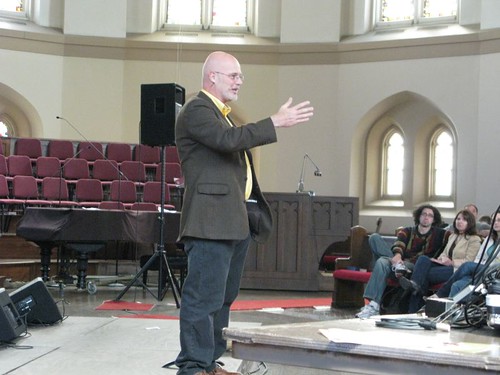
The sessions on Saturday were great, especially the point when Brian responded directly to comments made by Mark Driscoll (though Brian didn't name names) about Jesus being a "prize fighter with a tattoo down His leg, a sword in His hand and the commitment to make someone bleed." In contrast Brian shows how the New Testament presents Jesus as bringing peace and salvation not through the sword but through a commitment to let his own blood be shed. Whereas Driscoll says "I cannot worship a guy I can beat up", Brian reminded us that Jesus did let us beat him up, and that it was precisely though this non-violent act of love that the character of God's Kingdom was fully demonstrated.

Brian also had an excellent panel discussion later that morning with some local Chicagoans who were involved in various ministries connected to the issues Brian was addressing this weekend. I was especially impressed with Lynne Hybels, wife of Bill Hybels, the founding pastor of Willow Creek Community Church. She just told her story, and it turns out that she had gone through a very similar process of questioning and re-evaluating her faith that many of us emergent folks have, and was helped by Brian's books in the same way that many of us have as well. She described finding renewal of her faith by meeting Jesus in two new ways: 1) as a lover/resting place for her soul, and 2) as a social revolutionary. This combination of both the contemplative/mystical, and social activism is a common stream for many people, and it's encouraging to know that the leaders of one of the most influential churches in the nation are moving in this direction and consider people like Brian a friend and major influence.

Throughout the weekend we were also given opportunities to meditate and reflect on an artistic interpretation of the poetry of Denise Levertov entitled Nude Truths (done by the sisters Mary Ylvisaker Nilsen and Kristi Ylvisaker). I found this to be an excellent way to process some of the things we were hearing and thinking during the conference. I appreciated that Brian and Linnea took time to incorporate these sorts of experiences into what was ultimately a very short event, rather than just cramming it full of content.

That being said, I was rather disappointed that more time wasn't spent focusing on specific ways that we can bring about the kind of change that is necessary in the world. Because the panel discussion ran long, Brian was left with only about 20 minutes to run through seven diverse and complex ways that we can help change the world, which was not nearly enough time to let it really sink in or to engage with the possibilities. Personally I would have devoted at least an entire session to the question.

Hopefully we'll make up for it though in the upcoming weeks as our up/rooted cohort meets in several different places around the city to follow up on the ideas presented at the conference and to talk about how to actually put them into practical action. We had an overwhelming response at our cohort sign-up table this weekend. Over 40 people signed up for more info about up/rooted, and I think we'll also be able to help start a Southeast Wisconsin Cohort and an Evanston branch of up/rooted as well (not to mention re-starting our up/rooted.south branch down in the Joliet-Mokena-Tinley Park area.) As the official Emergent Village rep, I got to do a short presentation on cohorts during one of the conference sessions as well as host a lunch discussion about cohorts for those interested, and probably the best part of the whole conference for me was simply chatting and connecting with all those new people who were excited to meet others in their area who have been thinking in similar ways about their faith recently. As we repeated many times during the conference, "you're not the only crazy one out there!"

If you haven't yet attended the Tour, and can make it to Seattle this weekend, or Kansas City, New York City, or Goshen IN in the next month, I'd definitely recommend signing-up.

Labels: Brian McLaren, conferences, emerging church

 
posted by Mike Clawson at 3:14 PM | Permalink | 12 comments
Monday, April 07, 2008
Everything Must Change Tour Round-up
I spent this past weekend helping to coordinate the Everything Must Change Tour in Chicago. I love doing this sort of thing, helping plans come together and networking with new and old friends. Of course I've gotten very little sleep, spent yesterday mostly recovering from the event (I think I'm coming down with something), and today I have to get caught up on work that was put off for the conference, so I probably won't post a full recap of the event until tomorrow. In the meantime here are some articles and reviews on other blogs that you should check out if you're curious:

First an article written just before the conference in Oak Park's Wednesday Journal that I was interviewed for. I got to meet the author, Tom Holmes, briefly at the conference.

As usual Helen has a great play-by-play review of the conference. (And she gets the credit for the picture above. I forgot to bring my camera.)

Also check out some of Jason's raw notes on the sessions.

Chad Farrand, leader of the Mid-Michigan cohort whom I met for the first time this weekend, has a good recap of his experience as well.

And for a totally unique, very personal take in her usual "wonderfully rambling" style, check out my friend Rebecca's posts.

Also, regardless of whether you were there, you can contribute to this revolution and share ideas about how to bring real change over at the Everything Must Change web community.

And if you live near Seattle, Kansas City, Goshen IN, or New York City it's not too late to sign up to attend the Tour yourself.

Labels: Brian McLaren, conferences, emerging church, social justice

 
posted by Mike Clawson at 12:36 PM | Permalink | 2 comments
Wednesday, March 19, 2008
Cyclops?
I know I should just be ignoring these guys, but sometimes they're good for a laugh. Slice of Laodicea, one of those extreme fundamentalist "watchdog" sites, recently posted a warning about the "emergent takeover" of Cedarville University. The only reason I'm pointing it out is because it contains probably the funniest insult I've ever heard leveled at someone in the emerging church. Regarding a book endorsement by Brian McLaren, Slice had this to say:
Cedarville’s chapel speaker, Brad Kallenberg, is called “…this important theologian of the emerging church,” by the First Grand Cyclops of the emerging church.

Did they just call Brian McLaren "the First Grand Cyclops of the emerging church"? What the...?

Seriously, how do they come up with this stuff? I think that's the funniest thing I've read all week!

(Full disclosure: I actually ran for the post of "First Grand Cyclops" but after a scandal involving me, Tony Jones, a Volvo and a plunger back at the Glorieta Gathering, I was forced to withdraw my name from consideration. I'm still bitter.)

Labels: Brian McLaren, emerging church, fun

 
posted by Mike Clawson at 10:25 PM | Permalink | 5 comments
Layout design by Pannasmontata Header image © VladStudio